


AI can build a booking app in a weekend. Can it survive your peak season?
Key takeaways
- AI has made booking software for tour operators faster to build and cheaper to advertise. It has not made that software easier to run reliably in peak season.
- Veracode's 2026 research found AI-generated code passes security tests only 56% of the time, even though it is almost always syntactically correct.
- The hardest parts of tour, activity, and transportation booking live below the demo: shared resources, seats sold by segment, multi-channel inventory, and weather cancellations.
- AI amplifies the expertise of the team using it. Industry knowledge decides whether it helps or hurts.
- Test any vendor across five layers: operational logic, distribution, payments and compliance, reliability, and partnership.
The booking software market just got louder
If you run tours, activities, or ground transportation, you have probably noticed it. New booking platforms seem to appear every month. Their ads follow you across Google, Facebook, Instagram, and LinkedIn, promising AI-powered everything, setup in minutes, and prices that look hard to ignore.
Some of these products come from capable teams. Others may have been assembled in a matter of weeks with AI coding tools, by people who have never run a departure, dispatched a shuttle, or reconciled a busy weekend of OTA bookings. From the outside, the two can look almost identical. The websites are polished, the demos are smooth, and the feature lists are long.
That is the new reality of software in the age of AI. Building something that looks finished has never been cheaper or faster. Building something you can trust with your revenue, your customers' payment data, and your busiest Saturday in July is as hard as it ever was.
This article is about the difference between those two things, and how to tell them apart before you sign a contract. You will learn what AI has changed about how booking software gets built, why tour, activity, and transportation operations are harder to automate than they look, what the research says about AI-generated code, and which questions to ask any vendor before you trust them with your business.
The short version: AI is a powerful tool, and good software teams use it every day. But AI multiplies whatever knowledge sits behind it. In the hands of people who understand your industry, it produces better software faster. In the hands of people who do not, it produces confident-looking software that fails in ways you only discover when it is too late to switch.
What has AI changed about how booking software gets built?
AI has made it much faster and cheaper to produce software that looks finished. Tools that write code from plain-language instructions now let a small team, or even one person, generate a working booking website in days. The same work used to take months.
This way of building has a name. In February 2025, AI researcher Andrej Karpathy coined the term "vibe coding" for a style where you "fully give in to the vibes, embrace exponentials, and forget that the code even exists." By November 2025, Collins Dictionary had named vibe coding its 2025 Word of the Year.
Professional developers have adopted AI just as quickly. Google's 2025 DORA research found that nearly 90% of technology professionals now use AI in their work. In Stack Overflow's 2026 Developer Survey, only about 17% of developers said they did not use AI tools.
None of this is bad news on its own. Used well, AI helps experienced teams ship improvements faster, test more thoroughly, and spend more time on the problems customers care about. The issue is what AI made cheap, and what it did not.
What AI made cheap:
- A polished website and a smooth product demo
- Standard screens such as a booking calendar, a checkout page, and a customer list
- Ad creative, landing pages, and comparison pages, produced at scale
- A long feature list that sounds good on a sales call
What AI did not make cheap:
- Years of understanding how tour, activity, and transportation businesses really run
- Reliable two-way connections with the OTAs and resellers that drive your bookings
- Payment security and compliance that holds up to an audit
- Reliability under real peak-season load
- A support team that knows what a manifest is at 6 AM on a Saturday
That gap is where your risk lives. When building software looks this easy, the number of vendors goes up, the volume of advertising goes up, and the signal you need for a good decision gets harder to find. A bigger ad budget is not a product feature.
Why is booking software for tours, activities, and transportation so hard to build well?
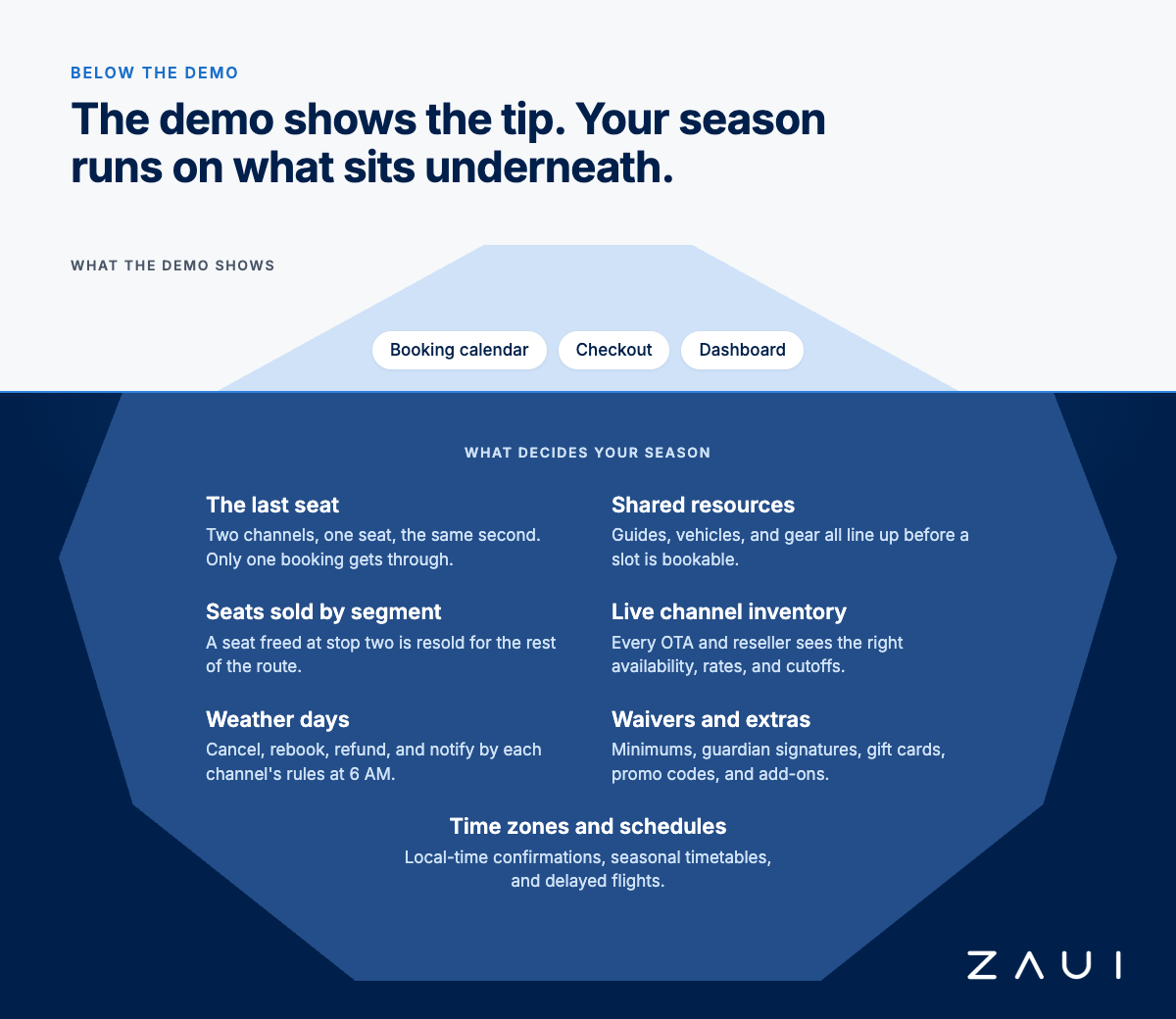
Because the hard part is not the booking screen. It is the operational logic behind it: shared resources, multi-channel inventory, payments, and cancellations. It is also the edge cases that only appear when real customers, real weather, and real peak-season volume hit the system at once.
Think of a booking platform as an iceberg. The demo shows you the tip: a clean calendar, a fast checkout, a dashboard full of charts. Underneath sits the part that decides whether your season runs smoothly. Here is some of what lives below the waterline.
- The last-seat problem. Two customers, one on your website and one on a reseller's site, try to book the final seat on a departure at the same moment. Well-built software lets exactly one of them through. Poorly built software sells both, and you find out when two people show up for one seat.
- Shared resources, not just time slots. A kayak tour may need one guide for every eight guests, a mix of single and double kayaks, and a van to reach the launch site. Capacity is not one number on a calendar. It is the point where every required resource is available at the same time, which is why resource scheduling matters so much.
- Seats sold by segment. A shuttle running from the airport through three towns to a ski resort sells seats leg by leg. A passenger who gets off at the second stop frees that seat for the rest of the route. Software built for multi-leg operations resells that seat. Software that treats a departure as one bucket either oversells or leaves revenue on the table.
- Real-time inventory across channels. If you sell through OTAs and resellers such as Viator, GetYourGuide, or Expedia, every channel needs accurate availability, rates, and cutoffs. A sync delay of a few minutes on a sold-out day can create double bookings, refunds, and damage to your standing on those channels.
- Weather days. When a storm forces you to cancel 40 bookings across five channels at 6 AM, your system has to cancel, rebook, refund, and notify each guest according to the rules of the channel they booked through. That one morning tests every part of a platform.
- Minimums, waivers, and extras. Tours that only run with four or more guests, waivers for every participant (including minors who need a guardian's signature), gift cards, promo codes, rentals, and add-ons each carry their own rules, accounting, and failure modes.
- Time zones and changing schedules. A guest in Sydney booking a tour in Vancouver needs a confirmation in the right local time. Seasonal schedules, daylight saving changes, and delayed flights for airport transfers all create situations that generic software handles badly.
None of these are exotic. For most operators, they are a normal week. Each one represents lessons that mature booking software has already absorbed, usually because a real operator hit the problem first and someone fixed it properly.
An AI coding tool can write the code for any of these features, if someone knows to ask for it and knows what correct looks like. That is the catch. AI does not know what it does not know, and neither does a team that has never built a departure manifest or worked a peak-season front desk.
What does the research say about AI-generated code?
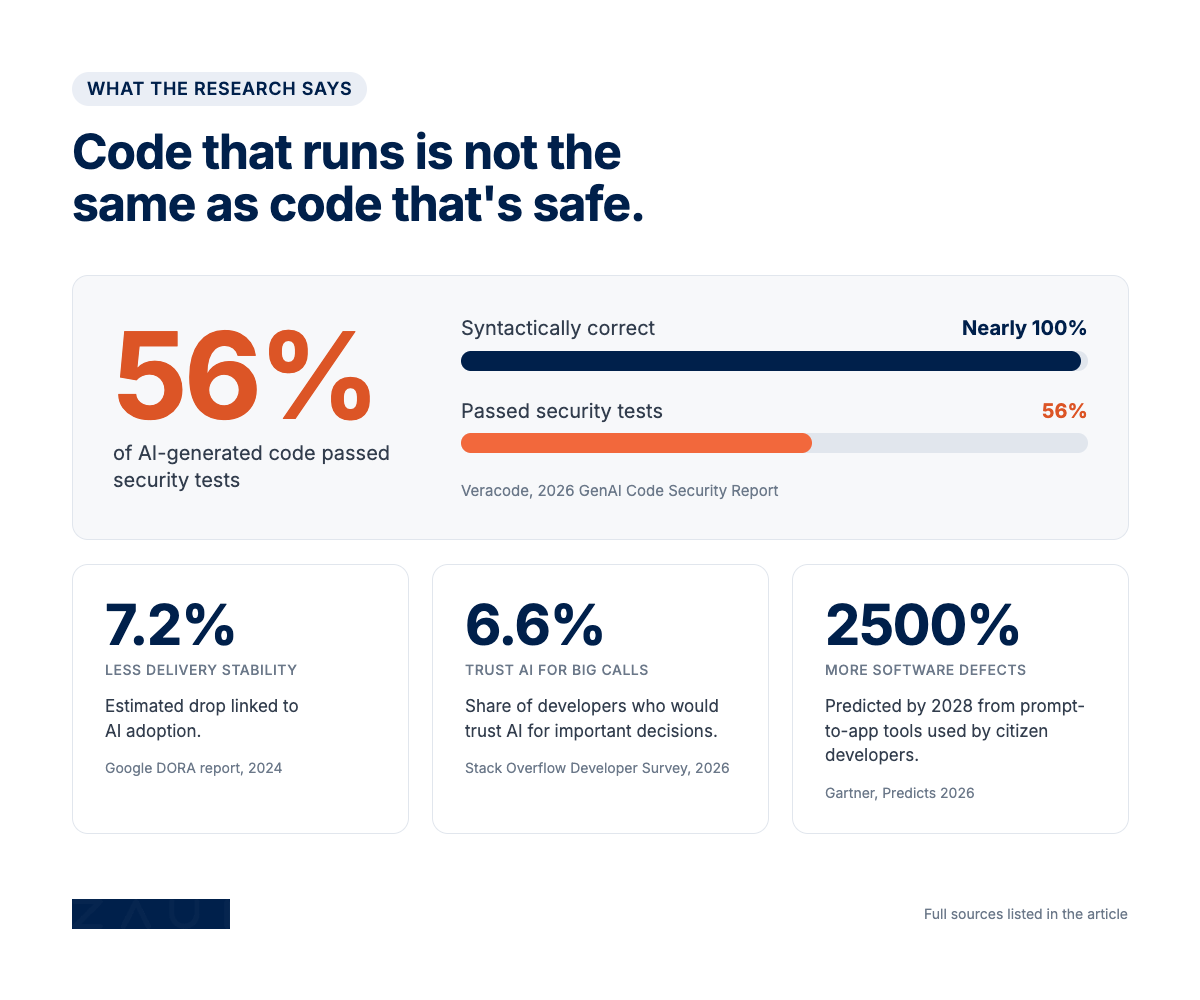
The research points in one direction. AI writes code that runs, but without expert review that code often carries security flaws and stability problems that are hard to spot. Those are the risks that matter most in software that handles payments and live inventory.
- Code that runs is not code that is safe. Veracode's 2026 GenAI Code Security Report found AI models now write syntactically correct code nearly 100% of the time. Yet that code passed security tests only 56% of the time, a rate virtually unchanged from the year before.
- Faster delivery, less stability. Google's 2024 DORA research linked AI adoption to an estimated 7.2% drop in software delivery stability. The 2025 DORA report found AI is now linked to faster delivery, while delivery instability continues to rise.
- Developers verify before they trust. In the 2026 Stack Overflow Developer Survey, only 6.6% of developers said they would trust AI for important decisions. Nearly half said they trust AI output when they can easily verify it.
- Analysts expect a quality crisis. Gartner predicts that by 2028, prompt-to-app approaches adopted by citizen developers will increase software defects by 2500%, "triggering a software quality and reliability crisis," according to ArmorCode's summary of Gartner's Predicts 2026 research.
The same Gartner research names the core problem. It warns that "a new class of defect is emerging as AI generates context-deficient code." It adds that these "deep, contextual bugs will be exponentially more expensive than fixing simple coding errors."
Context-deficient is the phrase to remember. In booking software, context means knowing that a shuttle seat can be resold once a passenger's leg ends. It means knowing that an OTA booking follows that channel's cancellation rules, and that a 6 AM weather call changes everything downstream. Code written without that context can pass every test its authors thought to write and still fail your business.
Real incidents show how fast this can go wrong. In July 2025, SaaStr founder Jason Lemkin reported that an AI coding agent on Replit erased a live production database during a code freeze, despite instructions not to make changes without approval. The database held records on 1,206 executives and more than 1,196 companies. Replit's CEO called the incident "unacceptable" and added new safeguards, including automatic separation of development and production databases.
None of this means AI-assisted software is bad by default. It means quality depends on the people who direct, review, test, and own the code. When you choose a booking platform, you are not only buying software. You are buying the judgment of the team behind it.
Why does industry knowledge matter more in the age of AI, not less?
Because AI amplifies whatever expertise it is given. Google's DORA research program puts it plainly in its 2025 report: "AI's primary role in software development is that of an amplifier." It magnifies the strengths of high-performing organizations and the dysfunctions of struggling ones.
Apply that to booking software. Give AI to a team that has spent years inside tour, activity, and transportation operations, and it helps them build the right things faster. They know which questions to ask, which edge cases to test, and what correct looks like when a reseller booking meets a weather cancellation. Give the same tool to a team without that background, and it helps them build the wrong things faster, with more confidence.
That is why a vendor's use of AI tells you very little on its own. Almost every software company now uses AI in some form. The questions that matter are about the people around it:
- Who directs the AI? People who understand operators, or people who mainly understand prompts?
- Who reviews the output? Is every change tested against real operating scenarios before it reaches your guests?
- Who owns the result? When something breaks in July, is there a team that understands the code well enough to fix it fast?
Industry knowledge also keeps a platform pointed in the right direction over time. Your needs keep changing as new channels, payment rules, and guest expectations appear. A vendor that understands your business can anticipate those changes. A vendor that learned your industry from a prompt will always be reacting, and you will be the one who discovers each gap.
Here is the simplest way to put it. AI can generate an answer to almost any question. Industry knowledge is knowing which questions to ask in the first place.
What makes booking software for tour operators resilient? The five-layer test
A resilient booking platform keeps taking bookings, protecting payments, and serving guests accurately when conditions are at their worst. That means peak volume, channel outages, weather disruptions, and regulatory change. You can test any vendor, new or established, across five layers.
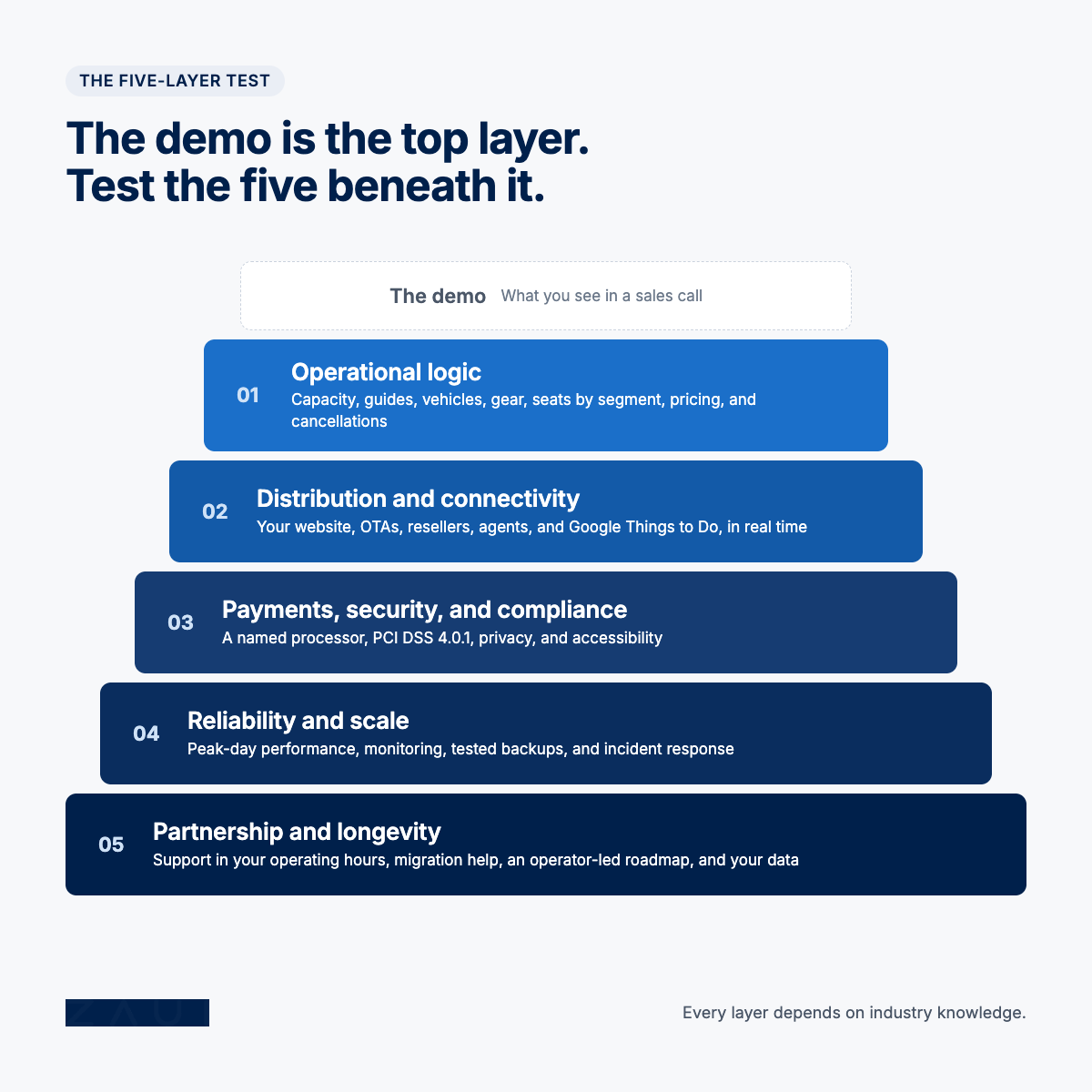
LayerWhat it coversWhat the demo showsBooking calendar, checkout, dashboards, a long feature list1. Operational logicCapacity, shared resources, seats by segment, pricing rules, cancellations2. Distribution and connectivityReal-time, two-way sync with OTAs, resellers, and your own website3. Payments, security, and compliancePCI DSS, data privacy, accessibility, and audit-ready records4. Reliability and scalePeak-season load, monitoring, incident response, tested backups5. Partnership and longevityPeak-season support, migration help, operator-led roadmap, your data
The demo only shows the top layer. Every layer below it depends on industry knowledge to get right.
1. Operational logic
This is the engine that turns your real-world operation into bookable inventory. It covers capacity, shared resources such as guides, vehicles, and equipment, seats sold by segment, pricing rules, booking policies, and cancellations.
Ask the vendor: Can you configure my most complicated product live, in front of me, without a workaround?
2. Distribution and connectivity
Most operators sell through several channels at once: their own website, OTAs, resellers, agents, hotel concierges, and Google Things to Do. Each channel needs accurate availability and rates in real time, and every sync failure needs to be caught quickly. Our guide to booking engine and OTA connectivity explains what good looks like.
Ask the vendor: Which channels do you connect to directly, and how will I know if a sync fails?
3. Payments, security, and compliance
Booking software handles cardholder data and personal information every day, usually through a payment gateway built into checkout. Since March 31, 2025, PCI DSS 4.0.1 has required that payment page scripts be "properly authorized, checked for integrity, and monitored for tampering," according to the PCI Security Standards Council. Privacy laws and accessibility standards add more obligations. Compliance is not a one-time build. It is ongoing work that a vendor has to staff for.
Ask the vendor: Who is your payment processor, and can you share your current PCI DSS attestation of compliance?
4. Reliability and scale
A platform has to perform on your busiest day, not on an average Tuesday. That depends on infrastructure, monitoring, tested backups, incident response, and the discipline to keep experiments away from live systems.
Ask the vendor: What was your uptime last peak season, and how do you tell customers when something goes wrong?
5. Partnership and longevity
Booking software is a relationship that lasts for years. You need support during your operating hours, real help with migration and onboarding, a roadmap shaped by operators, and confidence that your data stays yours.
Ask the vendor: Can I talk to three operators like me who have been with you for at least three seasons?
Demo-ready vs. operation-ready: how can you tell the difference?
A demo-ready platform performs well in a controlled sales presentation. An operation-ready platform performs well on your worst day of the season. Use this table to compare what you see in a demo with what you need in production.
What you are evaluatingDemo-readyOperation-readyBooking flowA clean checkout for a simple, single-ticket bookingGroups, add-ons, waivers, promo codes, and gift cards in one checkoutCapacityOne capacity number per time slotCapacity driven by guides, vehicles, equipment, and seats by segmentOTA and reseller sales"We integrate with OTAs"Named, maintained two-way connections with real-time availability and alerts when a sync failsCancellationsA cancel buttonChannel-specific policies, bulk weather cancellations, partial refunds, and automatic guest noticesPaymentsA payment form that worksA named processor, current PCI DSS compliance, and clear chargeback handlingPeak seasonTested with a handful of usersProven on high-volume days for operators like you, with monitoring and incident responseDataExports available on requestYou own your data, with documented exports and exit terms in your contractSupportA ticket queue during office hoursPeople who know tours and transportation, available when your operation is runningTrack recordA launch announcement and a few testimonialsOperators of your size and type who have stayed for several seasons
If a vendor's answers sit mostly in the middle column, keep asking questions. The difference between the two columns rarely shows up in a demo. It shows up in July.
What does it really cost to choose the wrong booking platform?
Far more than the subscription fee. The real cost shows up as lost bookings during outages, overbookings and refunds, damaged reviews and channel standing, staff hours spent on workarounds, and eventually a second migration.
Here is a simple way to size the risk. Imagine an operator with $2 million in annual bookings who earns 60% of that revenue in a 16-week peak season. That works out to roughly $10,700 in bookings per peak-season day: $1.2 million divided by 112 days. One day of downtime in July puts about that much at risk, before you count refunds, overtime, or guests who book a competitor instead. (Illustrative figures. Run the same math with your own numbers.)
The less visible costs add up too:
- Overbookings. Every double-sold seat means a refund, an apology, and sometimes a review that stays online for years.
- Channel standing. OTAs and resellers expect accurate availability. Repeated supplier-side cancellations can weaken your relationship with the channels that fill your departures.
- Staff time. Workarounds, double entry, and spreadsheet reconciliation quietly consume hours your team should spend on guests.
- Locked-in data. If your customer and booking history is hard to export, leaving a weak platform becomes slow and expensive.
- A second switch. Moving platforms twice in two years means retraining staff, reconnecting channels, and rebuilding products all over again.
This is not an argument against switching. Moving to a stronger platform is often worth it, and the off-season is the right time to do it. It is an argument for switching once, to a platform that has already proven it can carry a business like yours. Our tour operator software implementation guide shows how to plan a switch without disrupting live operations.
What questions should you ask a booking software vendor before you switch?
Ask questions that only an experienced, well-run vendor can answer well. Specific answers, real numbers, and live demonstrations are good signs. Vague answers, a quick pivot back to features, or pressure to sign before peak season are warning signs.
Use these 12 questions in your next demo:
- How long have you served operators like me, and how many are still with you after three seasons? Retention across seasons is proof that a platform survives real operations.
- Who on your team has worked in tours, activities, or transportation? Industry experience shapes every product decision, from how capacity works to how support is staffed.
- Can you show me, live, how your system handles my hardest scenario? Pick something real: a weather cancellation across five channels, a shuttle route sold by segment, or a group booking with mixed ages and waivers.
- Which OTAs and resellers do you connect to directly, and what happens when a sync fails? Ask how failures are detected, who is alerted, and how quickly they are resolved.
- Who processes payments, and can you share your current PCI DSS attestation of compliance? A confident vendor will answer right away.
- What was your uptime over the last 12 months, and do you publish incidents? Look for a status page, a clear incident history, and candid answers about what went wrong.
- How do you use AI to build your product, and how is AI-generated code reviewed before release? You want a clear answer about testing, human review, and accountability.
- What does support look like on a Saturday in peak season? Ask who answers, how fast, and whether they understand your type of operation.
- How do I export my data, and what happens to it if I leave? Your customer and booking history is one of your most valuable assets. Make sure the contract says so.
- What does migration look like, and who does the work? A good vendor has a proven process, a realistic timeline, and people who have done it many times before.
- How do operators influence your roadmap? The best platforms are shaped by the businesses that use them every day.
- Can I speak with three customers who run a business like mine? References from operators of your size, type, and region are worth more than any testimonial page.
Warning signs to watch for
- Ads everywhere, but few customers you can actually call
- "AI-powered" claims with no explanation of what the AI does or who checks it
- No named payment processor or PCI DSS documentation
- Pricing that is hard to pin down in writing
- Demos that stay on the happy path and avoid your edge cases
- Contracts with no clear terms on data ownership or export
For a deeper evaluation checklist, see our Tour Operator Software Buying Guide and How to Choose Tour Operator Software.
How does Zaui approach AI?
We believe AI should make experienced teams faster and operators more profitable. It should never replace the knowledge it takes to run a tour, activity, or transportation business, and it should never take decisions out of your hands.
Zaui is a Vancouver-based booking and operations platform built for tour operators, activity providers, and ground transportation companies. Our product decisions start with how operators work. Recent examples include service disruption tools that rebook affected passengers and notify them by email or SMS, booking policies that can be tailored by activity or sales channel, upgraded resource assignment, and more than 90 integrations. Our 2025 year in review covers each of these.
The same thinking shapes how we use AI inside the product. NERA AI is Zaui's built-in operations intelligence layer. It flags problems before they reach guests, such as a departure with no guide assigned, an OTA integration that stopped syncing, or a pricing anomaly.
Two design choices reflect what operators have taught us:
- Signal over noise. When our team tested NERA AI across hundreds of accounts, it generated nearly 12,000 potential insights in one batch. Strict significance filters cut that to 42 notifications, suppressing more than 99% of low-value alerts, as our introduction to Nera explains.
- Guidance, not enforcement. NERA AI recommends. You decide. It will never change a price or open new departures without your input.
That is what AI looks like when it is built on industry knowledge. It knows which signals matter to an operator, and it respects who is running the business.
The bottom line: choose knowledge over noise
The booking software market will keep getting louder. AI will keep making it cheaper to build products and easier to advertise them. Some of what it produces will be excellent, and much of it will not survive a busy season.
Your job is not to avoid AI. It is to make sure the platform running your business was built by people who understand that business. Look past the ads and the demo. Test the layers underneath. Ask the questions that only experience can answer, and talk to operators who have been through several peak seasons on the platform.
The operators who win the next decade will not be the ones with the newest software. They will be the ones whose software works on their busiest day.
See the difference for yourself: Book a demo, bring your hardest scenario, and we will walk through it with you live.
Frequently asked questions
Is AI-built booking software safe for a tour or transportation business?
It can be, but only when experienced people direct, review, and test the code. Veracode's 2026 research found AI-generated code passed security tests just 56% of the time. Ask any vendor how AI-written code is reviewed, who owns it, and how they prove it works under peak-season load.
What is vibe coding?
Vibe coding means building software by describing what you want to an AI tool and accepting the code it generates, often without reading it closely. Andrej Karpathy coined the term in February 2025, and Collins Dictionary named it its 2025 Word of the Year. It suits quick prototypes far better than business-critical systems.
What should tour operators look for in booking software?
Look for depth in five layers: operational logic for your product types, real-time distribution to OTAs and resellers, payments and compliance, reliability at peak volume, and a long-term partnership with responsive support and data portability. The best evidence is operators like you who have stayed on the platform for several seasons.
How can I tell if a booking platform is reliable before I switch?
Ask for 12 months of uptime history and an incident record, then test your hardest scenario live in the demo. Speak with at least three customers who run a business like yours. Reliable vendors answer with specifics and real numbers rather than general reassurance.
Does it matter if my booking software vendor uses AI?
Using AI is not a red flag on its own, since almost every software company uses it now. What matters is who directs it, who reviews its output, and who is accountable when something breaks. AI in the hands of a team with deep industry knowledge is an advantage. Without that knowledge, it multiplies risk.
When is the best time to switch booking software?
The off-season, well before your next peak. That gives you time to migrate data, reconnect channels, configure products, and train staff without disrupting live operations. For many summer-season operators, late fall and winter are the ideal window to prepare for the year ahead.
What is PCI DSS, and why does it matter for booking software?
PCI DSS is the security standard for businesses that store, process, or transmit payment card data. Since March 31, 2025, version 4.0.1 has required e-commerce payment pages to authorize, verify, and monitor the scripts that run on them. Your booking platform and payment processor should be able to show current compliance on request.
Related Posts


Upgrade Your Journey: Zaui Introduces Exciting New Features to its Transport Booking System
Learn all you need to know about the efficient and reliable transport booking system, including the latest enhancements introduced by Zaui.

Culinary Tourism: What It Is, Why It Is Growing, and How Operators Can Capitalize
A guide to culinary tourism for experience operators: what it is, who the customers are, what drives the category's growth, and how to build and market food-based experiences.

Frequently Asked Questions
No. Zaui’s pricing is fully pay-as-you-go. You aren’t locked into any long-term contract. In fact, leading platforms emphasize this flexibility. Similarly, Zaui lets you start and stop anytime. You can change or cancel your plan freely, so you only pay for what you use.
Absolutely not. Zaui’s pricing is 100% transparent. We disclose all fees up front with no surprise add-ons or “sneak-in” charges. In fact, Zaui’s plans include all core features “without additional fees”. Industry experts note that hidden fees undermine trust so we avoid them entirely. All costs are clearly outlined in our pricing, and there are no extra setup charges or undisclosed surcharges at checkout.
Zaui integrates with major payment gateways (e.g. Stripe) so you only pay standard credit-card processing rates (roughly 1.9%+$0.30/transaction) and we don’t mark them up. Only the published platform commission is added on bookings. You also have full control over who pays the commission, we let you decide whether to absorb booking fees or pass them on to customers. In short, you’ll only pay the transparent booking commission and normal gateway fees, nothing extra.
Your onboarding and support are included in the price. We provide white-glove setup help and ongoing 24/7 support at no additional cost. Our dedicated customer-success team will guide you through every step, ensuring a smooth launch. You won’t pay extra for training or service other than the onboarding fee; it's all built into your plan.
You can schedule a free demo with our team. Our Zaui ninjas will walk you through pe how Zaui can work for your business and highlight opportunities to grow with our advanced features all without any upfront payment. This way, you can feel confident it’s the right fit before making a commitment.
Of course. Zaui’s plans are fully flexible. You can upgrade or downgrade at any time to match your needs, without penalties. You can move to a higher tier or back down easily, and your billing adjusts automatically.
No. Zaui does not charge its commission on offline/manual bookings. “No fees on offline bookings” You only pay the commission when a booking is processed online through our system. Manual reservations (or bookings from partner channels we set up for you) incur no extra platform fee. (30% or less)
All of Zaui’s core features are included in your plan at no extra charge. We believe in value and transparency: Zaui provides over 15 advanced features (Google Things to do, reporting tools, marketing tools, reports, etc.) at no additional cost. Many competitors charge extra or require higher plans for the same features, but with Zaui you get the full suite of tools in one package. Any optional add-ons (if any) will always be clearly listed and optional there are no surprise paid upgrades for standard features.
Each Zaui plan is designed for clarity and fairness, following industry best practices. You can trust that our pricing is transparent and flexible, with the support you need built in.
Extra accounts- unlimited agents, resellers, user
