


If most of your business is one-off charter trips, that is, a customer calls or fills out a form asking for a bus for a wedding, a sports team, or a corporate event, and you build a custom quote and dispatch a vehicle for that single trip, Busie is built around exactly that workflow and is likely the more direct fit. If your business runs scheduled, recurring departures on fixed routes, sells seats online against live inventory, operates multi-leg or connected itineraries such as airport transfers that hand off to city tours, or needs to distribute inventory through OTAs and reseller channels while managing a large fleet across multiple bases, Zaui is built for that kind of operation and is the stronger match. Some coach companies run both models at once. In that case the right answer depends on which side of the business generates more volume and where the operational pain actually is, and later sections of this article will help you figure that out in more detail.
What Busie Is Built For
Busie describes itself as an all-in-one platform that digitizes the entire charter bus operation lifecycle, from initial customer quotes through driver dispatch and payment processing. That description matters because it tells you exactly what problem the product was designed to solve: the charter workflow, where every trip starts as an inbound request that has to be turned into a quote, then a booking, then a dispatched vehicle and driver, then an invoice. Busie's own site lists dispatch, vehicle availability and management, driver availability and management, and a named route-optimization product called Pathfinder Routing as core parts of the platform. It also includes CRM functionality, reporting and analytics, quoting and booking management, tools for capturing customer leads through the operator's own website, automated follow-ups, contracts, invoicing and payments, and a digital marketing and SEO service offered as an add-on.
That combination makes sense for charter and motorcoach operators, from small independents up to larger fleets, who spend their day fielding requests, building custom quotes, and figuring out which vehicle and driver are free for a given date. The lead capture and follow-up tools point at a sales-driven business model where new inquiries are the lifeblood of the operation, and the contracts and invoicing tools point at a world where every booking is negotiated and priced somewhat individually rather than sold off a fixed public schedule. If this sounds like your day-to-day, Busie's tools are pointed directly at the problems you actually have.
What Zaui Is Built For
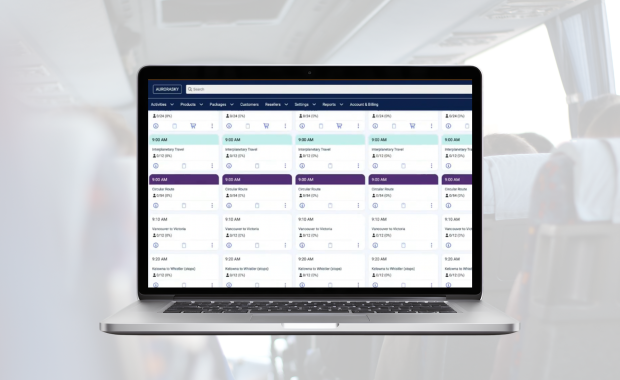
Zaui has spent over 20 years building booking, dispatch, and reservation software out of Vancouver for tour operators, activity providers, and ground transportation companies, and its architecture reflects a different starting assumption: that the operator is selling seats against a published schedule rather than negotiating one-off trips. The center of the platform is the Booking Desk, an operations dashboard that shows daily, weekly, and monthly views of scheduled activities and departures, with columns for available seats, capacity percentage, booked count, total capacity, the vehicle assigned, and the employees (drivers or guides) assigned to each departure. When a departure is overbooked or running into negative capacity, the Booking Desk shows a red lightning-bolt icon and a warning such as "-7 (8%)"; when a departure is approaching capacity, it shows a yellow warning triangle or circle instead, so dispatchers can see problems at a glance rather than digging through a spreadsheet.
Around that dashboard, Zaui provides a route and schedule builder, referred to in its own marketing as "build a schedule once, sell it everywhere," that lets an operator define multiple locations with per-day-of-week selection, and flag each stop as a hub, drop-off, pickup, mandatory stop, rest stop, or milestone, with arrive and depart times set per location. Zaui also supports multi-leg and connected itineraries, where a single booking can span several legs, for example an airport pickup, a city transfer, and a final drop-off, with the schedules for each leg staying in sync and a single passenger record following the traveler through every leg. On the distribution side, Zaui connects to major OTAs and, per its own marketing, to leading transportation resellers including Wanderu, Busbud, and Distribusion, in addition to Viator, GetYourGuide, Expedia, and Google Things to Do. Underneath all of this sits NERA AI, Zaui's operations intelligence and alerting layer, which surfaces anomalies and capacity issues across the schedule. For a closer look at how the dashboard itself works day to day, see this breakdown of the Booking Desk for coach dispatch operations.
Scheduling and Fixed Routes
This is where the two platforms diverge most clearly. Busie's product language, dispatch, vehicle and driver availability, routing, quoting, is the language of charter work: each trip is planned individually, priced individually, and dispatched individually. There is no indication in Busie's own materials that the platform is organized around a recurring, published timetable sold as public seat inventory the way an intercity bus route or a scheduled airport shuttle would be.
Zaui's scheduling model is built the other way around. An operator uses the Locations builder to define a route once, with its stops, days of operation, and timing, and that route then generates recurring scheduled departures automatically, each one appearing on the Booking Desk with its own seat inventory. Because the schedule is defined once and reused, a company running the same route five, ten, or twenty times a week does not need to recreate the trip from scratch each time the way a charter quote would. If your business is closer to a fixed, published timetable, whether that is a scheduled shuttle route, an intercity coach line, or a repeating sightseeing circuit, this structural difference is the single biggest reason to look closely at Zaui rather than a charter-first tool. This distinction is explored further in this guide to intercity scheduled bus booking software.
Dispatch, Resource Assignment, and the Booking Desk
Both platforms deal with the practical question of which vehicle and which driver go on which trip, but they approach it from different starting points. Busie's dispatch tools are built around assigning resources to individual charter jobs as they come in and get quoted, which fits a business where the schedule itself is being built new every day out of incoming requests. Zaui's resource scheduling and resource assignment tools work against the Booking Desk's existing grid of scheduled departures: a dispatcher looks at the day's or week's departures, sees which ones already have equipment and employees assigned and which ones are still open, and fills in vehicles and drivers against a schedule that was already built by the Locations tool. The alerting built into the Booking Desk, the red lightning-bolt overbooking warning and the yellow near-capacity warning, is specifically about departures running against a fixed seat count, which is a different kind of problem than confirming availability for a one-off charter quote. Operators evaluating both tools side by side often find it useful to read a broader breakdown of motorcoach booking software options before narrowing down to a single platform.
It is worth being direct about where Zaui is not the right tool: taking an inbound, one-off charter request, quoting it on the spot, and dispatching a vehicle against that single job is not the workflow Zaui was built around. That is precisely the workflow Busie was built around, and if that describes the majority of your bookings, Busie's dispatch and quoting tools will likely feel more natural day to day than trying to bend a scheduled-departure platform into a charter quoting tool.
Multi-Leg and Connected Itineraries
One of Zaui's more distinctive capabilities for coach and motorcoach operators is multi-leg or connected itinerary support, where a single booking can span multiple legs, such as an airport pickup, a city transfer, and a final drop-off, with the schedules for each leg staying in sync and one passenger record carried across every leg rather than the traveler having to be re-booked or re-entered at each stage. This matters for operators who sell connected products rather than single point-to-point trips, for example a coach company that picks passengers up at the airport, transfers them to a hotel, and later runs them out to a day-trip departure, all as one purchase from the customer's point of view.
Busie's published materials do not describe a comparable connected-leg itinerary structure. Its workflow is oriented around individual charter jobs, which may themselves involve multiple stops on a route (which is what Pathfinder Routing is for), but that is a different thing from a single passenger record moving through several separately scheduled legs that stay synchronized with each other. If your business depends on selling connected, multi-leg journeys as a single product, this is an area where Zaui's architecture has a real, verifiable advantage.
OTA and Reseller Distribution
Distribution is another area of real difference. Zaui connects with major OTAs and, according to its own marketing, with leading transportation resellers including Wanderu, Busbud, and Distribusion, alongside Viator, GetYourGuide, Expedia, and Google Things to Do. For an operator selling scheduled seat inventory, this kind of reach into transportation-specific resale channels, not just general activity OTAs, is directly relevant, since Wanderu, Busbud, and Distribusion specifically aggregate scheduled ground transportation rather than charter bookings. A deeper look at this side of the platform is available in this piece on coach OTA and reseller distribution software.
Busie's own site does not list integrations with OTA or reseller distribution channels among its named product areas; its lead generation tools are oriented around capturing inquiries through the operator's own website rather than distributing published inventory through third-party marketplaces. That makes sense given its charter focus: charter trips are typically quoted directly with the customer rather than sold as browsable inventory on a resale marketplace. If distribution through resellers and OTAs is a meaningful part of your growth plan, this is another point in Zaui's favor; if your bookings come primarily from direct inquiries and referrals, it may matter less to you.
Reporting and Integrations
Zaui offers more than 135 pre-built reports along with custom reporting and the ability to deliver data to third-party tools and systems, backed by more than 100 pre-built integrations, a dedicated integration layer called Zaui Connect, and a Channel Manager for coordinating distribution across sales channels. For payments specifically, Zaui supports more than 17 payment gateways, with Stripe, Square, PayPal, and Authorize.Net named directly on its site.
Busie lists reporting and analytics as one of its core product areas as well, alongside invoicing and payments, though its own materials do not specify a report count or a named list of payment gateways the way Zaui's do. Both platforms treat reporting as a core part of running the business rather than an afterthought, which makes sense: whether you are managing charter jobs or scheduled departures, operators need visibility into revenue, utilization, and performance. The difference is more in orientation than in the presence or absence of reporting, with Zaui's reporting built around scheduled departure and capacity data and Busie's built around quote-to-job performance and dispatch data.
Which Platform Fits Your Operation
If you run a charter and motorcoach business where the phone rings, or a form gets submitted, and every job starts as a custom quote for a wedding, a sports team, a school trip, or a corporate group, and your day is spent matching those jobs to available vehicles and drivers, Busie's dispatch, routing, CRM, and quoting tools are purpose-built for that workflow and are worth taking seriously. Busie's lead capture and follow-up tools, along with its optional digital marketing and SEO add-on, also suggest it is aimed at operators whose growth depends heavily on winning new charter inquiries.
If instead you run scheduled routes with recurring departures, sell seats online against live inventory, operate connected multi-leg itineraries, need distribution through OTAs and ground-transportation resellers like Wanderu, Busbud, and Distribusion, or manage a larger enterprise fleet where visibility across many departures, vehicles, and employees at once is the daily challenge, Zaui's Booking Desk, Locations builder, multi-leg support, and distribution network are built directly around those needs. Many motorcoach operators fall clearly into one category or the other once they look honestly at where their booking volume actually comes from. For operators still weighing the decision, this guide to choosing coach booking software walks through the questions worth asking before committing to either kind of platform, and this coach and motorcoach software comparison lays out how several platforms in the category stack up against each other more broadly.
It is also worth acknowledging that some operators run a hybrid business, doing scheduled route work during peak season or on core corridors while also taking on charter work to fill gaps. For those operators, the honest answer is that neither platform is likely to cover both workflows equally well, since Busie is not built around fixed recurring schedules and Zaui is not built around one-off charter quoting and dispatch. In that situation, the deciding factor should be which side of the business represents more of your revenue and where your current operational pain is worst, rather than trying to find a single tool that treats both workflows as a first-class feature.
Frequently Asked Questions
Does Zaui handle one-off charter bookings at all?
Zaui is built around scheduled, fixed-route, and multi-leg operations rather than the on-demand charter quote-to-dispatch workflow. An operator whose business is primarily one-off charter requests, quoted individually and dispatched as single jobs, will likely find a charter-focused tool like Busie a more direct fit for that specific workflow.
Does Busie support fixed, recurring scheduled routes the way Zaui does?
Busie's own product materials describe dispatch, routing, vehicle and driver management, and quoting built around the charter job lifecycle rather than a published, recurring timetable with live seat inventory. Operators running fixed scheduled routes should evaluate Zaui's Locations builder and Booking Desk directly against their needs.
Can Zaui manage a large, multi-base motorcoach fleet?
Yes. Zaui's Booking Desk provides a central dashboard across daily, weekly, and monthly views showing vehicle and employee assignments, capacity, and live alerts for every scheduled departure, which is designed for enterprise-scale fleet visibility. More detail is available in this overview of motorcoach fleet management software.
Does Busie offer OTA or reseller distribution?
Busie's own site does not list OTA or reseller marketplace distribution among its named product areas. Its lead generation tools are built around capturing inquiries directly through the operator's own website rather than distributing inventory through third-party resale channels.
What is Pathfinder Routing?
Pathfinder Routing is a named route-optimization product within Busie's platform, built to help charter operators plan efficient routes for individual trips as they are quoted and dispatched.
What is NERA AI in Zaui?
NERA AI is Zaui's operations intelligence and alerting layer, which surfaces anomalies and capacity issues across scheduled departures so dispatchers can catch problems before they affect passengers.
Which payment gateways does Zaui support?
Zaui supports more than 17 payment gateways, with Stripe, Square, PayPal, and Authorize.Net named directly on its site.
Can a hybrid operator, running both charter and scheduled work, use either platform for everything?
Not cleanly. Busie is not built around fixed recurring schedules, and Zaui is not built around on-demand charter quoting and dispatch. Hybrid operators are generally better served by identifying which side of the business generates more volume and choosing the platform built for that workflow, or by treating the two as separate operational problems.
Where can I read independent feedback from coach operators who use Zaui?
A collection of operator feedback is available in this roundup of Zaui reviews from bus and coach operators.
Should I compare pricing between Zaui and Busie directly?
Neither company publishes detailed public pricing for enterprise motorcoach deployments, since pricing typically depends on fleet size, feature set, and contract terms. Contact each vendor directly for current pricing based on your specific fleet size and operational needs.
Related Posts

Frequently Asked Questions
No. Zaui’s pricing is fully pay-as-you-go. You aren’t locked into any long-term contract. In fact, leading platforms emphasize this flexibility. Similarly, Zaui lets you start and stop anytime. You can change or cancel your plan freely, so you only pay for what you use.
Absolutely not. Zaui’s pricing is 100% transparent. We disclose all fees up front with no surprise add-ons or “sneak-in” charges. In fact, Zaui’s plans include all core features “without additional fees”. Industry experts note that hidden fees undermine trust so we avoid them entirely. All costs are clearly outlined in our pricing, and there are no extra setup charges or undisclosed surcharges at checkout.
Zaui integrates with major payment gateways (e.g. Stripe) so you only pay standard credit-card processing rates (roughly 1.9%+$0.30/transaction) and we don’t mark them up. Only the published platform commission is added on bookings. You also have full control over who pays the commission, we let you decide whether to absorb booking fees or pass them on to customers. In short, you’ll only pay the transparent booking commission and normal gateway fees, nothing extra.
Your onboarding and support are included in the price. We provide white-glove setup help and ongoing 24/7 support at no additional cost. Our dedicated customer-success team will guide you through every step, ensuring a smooth launch. You won’t pay extra for training or service other than the onboarding fee; it's all built into your plan.
You can schedule a free demo with our team. Our Zaui ninjas will walk you through pe how Zaui can work for your business and highlight opportunities to grow with our advanced features all without any upfront payment. This way, you can feel confident it’s the right fit before making a commitment.
Of course. Zaui’s plans are fully flexible. You can upgrade or downgrade at any time to match your needs, without penalties. You can move to a higher tier or back down easily, and your billing adjusts automatically.
No. Zaui does not charge its commission on offline/manual bookings. “No fees on offline bookings” You only pay the commission when a booking is processed online through our system. Manual reservations (or bookings from partner channels we set up for you) incur no extra platform fee. (30% or less)
All of Zaui’s core features are included in your plan at no extra charge. We believe in value and transparency: Zaui provides over 15 advanced features (Google Things to do, reporting tools, marketing tools, reports, etc.) at no additional cost. Many competitors charge extra or require higher plans for the same features, but with Zaui you get the full suite of tools in one package. Any optional add-ons (if any) will always be clearly listed and optional there are no surprise paid upgrades for standard features.
Each Zaui plan is designed for clarity and fairness, following industry best practices. You can trust that our pricing is transparent and flexible, with the support you need built in.
Extra accounts- unlimited agents, resellers, user
