


Quick Answer
If you run tours, activities, passenger transport, or any combination of the three, you are looking for a platform that handles bookings, payments, availability, and customer communication in one place. The five platforms operators compare most often are Zaui, FareHarbor, Rezdy, Checkfront, and Bokun. The right choice depends on what you operate (tours only, transport only, or both), how large your business is, and which distribution channels you need to connect to. Zaui is the strongest option for operators who manage both tours and passenger transport in a single system and want OTA distribution without being locked into a third-party ecosystem. FareHarbor is better suited to operators who want no upfront subscription cost and sell heavily through Booking.com. Rezdy is a strong fit for activity operators with heavy OTA distribution in the Asia Pacific region. The sections below walk through each platform in detail.
Introduction
The number of tour and activity booking platforms available to operators has grown significantly in the past decade. Where operators once had only a handful of credible options, you now face a decision among dozens of platforms, some built for general use, others purpose-built for specific operator types like transportation companies, multi-day tour companies, or water-based experience providers.
This guide covers the five platforms that appear most often in operator evaluations: Zaui, FareHarbor, Rezdy, Checkfront, and Bokun. It is not a sponsored ranking. Each platform is described based on its publicly documented capabilities, business model, and the operator types it is most commonly used by. Pricing models and specific feature details change over time, so you should verify current information directly with each provider before making a decision.
By the end of this guide, you will have a clear picture of what separates these platforms, which types of operations each one is best suited for, and what questions to ask before you commit to any of them.
If you are still working out what you actually need from a booking platform before comparing specific products, start with the how to choose tour operator booking software guide first, then come back here.
How This Guide Was Put Together
The descriptions and comparisons in this guide are based on publicly available product documentation, operator community discussions, and the feature sets each provider markets. Where we describe Zaui's capabilities, we have first-hand knowledge of the product. For competitor platforms, we have summarized based on what is publicly documented and widely reported by operators who use those tools. No ratings or feature claims in this guide are fabricated.
What Good Tour and Activity Booking Software Actually Does
Before comparing platforms, it is worth being clear about what a booking platform needs to do well to be worth using in a growing operation.
Core capabilities every platform must have
Every credible tour and activity booking platform should handle: online booking for your customers - a widget or page where customers can browse availability, choose a time, enter their details, and pay, working on your website and on mobile; real-time availability management when a booking comes in through any channel, it should immediately reduce available capacity everywhere else; payment processing; accepting credit cards, handling deposits, processing full payments, and managing refunds; customer records, a central record for each customer including booking history, contact details, waiver status, and any notes; and basic reporting - total bookings, revenue by period, booking source, and capacity utilization at a minimum.
Features that separate basic platforms from more capable ones
OTA channel management is the ability to list your products on platforms like Viator, GetYourGuide, Expedia, and Airbnb Experiences, with availability syncing automatically. Not all platforms support the same set of OTAs, and the depth of integration varies.
Resource scheduling is the ability to track which guides, vehicles, boats, or other assets are assigned to which bookings, and to prevent double-booking those assets across different products or time slots.
Multi-day itinerary management is the ability to structure a booking that spans several days, potentially with different activities, pickup points, or accommodation arrangements on each day. Not all platforms handle this well.
Seat management and passenger manifests are specific to transport operators. If you run shuttles, coaches, ferries, or any vehicle-based service, you need to assign passengers to specific seats, generate a manifest before departure, manage cancellations and substitutions, and track pickup points along a route.
Dynamic pricing is the ability to vary your prices based on demand, time until departure, day of the week, or other rules. Very few platforms offer this natively. Zaui's dynamic pricing functionality is one of the more developed implementations available.
Google Things to Do integration allows your products to appear in Google Search and Google Maps with a direct booking link. Customers searching for things to do in your area can find and book you without leaving Google. See the full Google Things to Do guide for operators for more detail on how it works.
The Five Platforms Tour Operators Compare Most
Zaui
Zaui was founded in Vancouver, Canada in 1999 and has been used by tour operators, transportation companies, ferry operators, and activity providers for over two decades. It is a cloud-based reservation management system designed to handle the full range of bookings that tourism businesses run, from single-activity day tours to complex passenger transport routes to multi-day adventure packages.
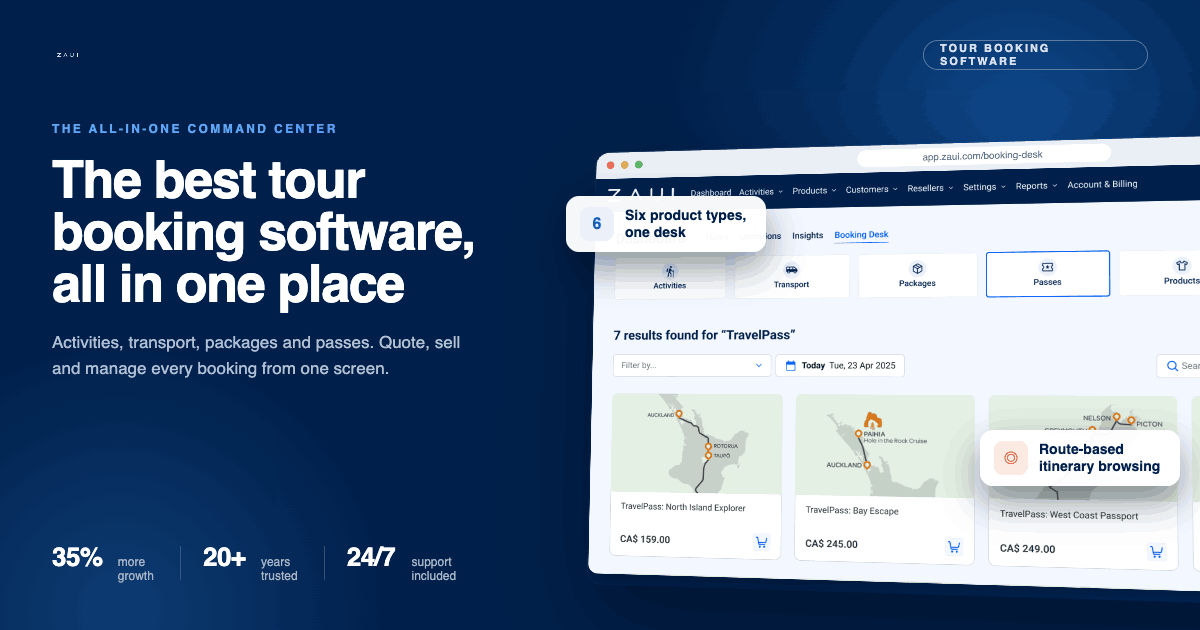
What Zaui is built for: Zaui is the strongest platform in this comparison for operators who manage both tours and passenger transport in a single system. Its transport-specific capabilities; seat manifests, route management, recurring schedules, pickup and drop-off points, and passenger tracking are more developed than those found in FareHarbor, Rezdy, or Checkfront. Beyond transport, Zaui handles activity bookings, resource scheduling, OTA distribution through integrations with Viator, GetYourGuide, Expedia, and others, and Google Things to Do connectivity. NERA AI is Zaui's built-in operations intelligence layer. It monitors booking data and flags issues operators need to act on; activities approaching expiry, pricing anomalies, security access issues, and integration errors as alerts rather than buried reports. Zaui's Booking Desk gives front-desk staff a dedicated interface for managing walk-in bookings, phone reservations, and agent sales alongside online bookings, all within the same system.
Pricing model: Zaui offers a free plan, which makes it accessible to new and small operators. Pricing scales with usage, so you pay more as your booking volume grows rather than committing to a large subscription up front.
Who Zaui is best for: Operators who run tours and passenger transport together. Shuttle, bus, and ferry operators who need seat manifests and route management. Tour companies that want OTA distribution without paying ongoing platform commissions to a third party. Businesses in Canada, the United States, Australia, New Zealand, and the United Kingdom. Operators who want to scale from a small operation to an enterprise-level deployment without switching platforms.
What to keep in mind: Zaui has fewer public reviews on third-party review sites like G2 and Capterra than FareHarbor does. The onboarding process for complex operations with transport, tours, and multiple product types takes time to set up properly.
FareHarbor
FareHarbor was founded in Honolulu in 2013 and was acquired by Booking Holdings - the parent company of Booking.com and Priceline in 2018. It is one of the most widely installed platforms in the North American tour and activity market, particularly among operators who sell through Booking.com.
What FareHarbor is built for: FareHarbor is a general-purpose tour and activity booking platform with a large install base and substantial ecosystem of third-party tools. Its strongest distribution advantage is the Booking.com relationship, operators on FareHarbor have a direct path to being listed on Booking.com Experiences. FareHarbor does not charge a monthly subscription fee; instead, it takes a percentage of each booking. Transport-specific features; seat manifests, route scheduling, recurring transport runs are not a FareHarbor strength.
For a detailed feature comparison, see the full Zaui vs FareHarbor comparison.
Rezdy
Rezdy was founded in 2011 in Sydney, Australia. It is used primarily by activity operators and has a strong presence in the Asia Pacific region. Rezdy's core strength is OTA connectivity and reseller channel management, with direct integrations with a broad set of OTAs and a well-developed agent and reseller booking portal. Passenger transport features are limited. Multi-day tour management is less developed than in Zaui or Checkfront.
Checkfront
Checkfront is a Canadian company based in Victoria, British Columbia, founded in 2011. It is a flexible platform designed to handle a range of bookable product types - not just tours and activities, but also hourly rentals, multi-day bookings, and accommodation add-ons. OTA connectivity is less extensive than Rezdy or FareHarbor. Transport-specific features are basic.
Bokun
Bokun was founded in Iceland in 2012 and was acquired by TripAdvisor in 2018. It is now part of the Viator ecosystem. Bokun's primary differentiation is its position within the TripAdvisor and Viator distribution network. Direct booking features are less developed than Zaui or Checkfront. Transport and seat management features are limited.
Side-by-Side Feature Comparison
The table below compares the five platforms across the features operators most commonly evaluate. Features marked as Limited indicate the platform offers partial functionality in this area but not at the same depth as platforms marked Yes.
| Feature | Zaui | FareHarbor | Rezdy | Checkfront | Bokun |
|---|---|---|---|---|---|
| Pricing model | Free plan plus subscription | Commission per booking | Subscription plus per-channel fees | Subscription tiers | Commission per booking |
| Transport and seat management | Yes, dedicated tools | Limited | Limited | Basic | Limited |
| OTA connectivity | Strong, multi-channel | Strong, Booking.com advantage | Strong, Asia Pacific focus | Limited | Strong, Viator and TripAdvisor |
| Multi-day itinerary management | Yes, dedicated tools | Partial | Limited | Yes, flexible | Limited |
| Dynamic pricing | Yes, included | No | No | No | No |
| NERA AI operations alerting | Yes | No | No | No | No |
| Google Things to Do integration | Yes | Available | Available | Limited | Available |
| Free plan | Yes | No | No | No | No |
Note: Platform capabilities change over time. Verify current feature availability directly with each provider before making a decision.
Who Each Platform Is Best For
Zaui is the best fit if you run both tours and passenger transport from one system, if transport-specific features are important to your operation, or if you want OTA distribution and dynamic pricing without being tightly integrated into a single third-party marketplace ecosystem.
FareHarbor is the best fit if Booking.com is a significant distribution channel for you, if you prefer not to pay a monthly subscription, or if you want a large ecosystem of third-party tools built around your platform.
Rezdy is the best fit if OTA and reseller channel management is your primary distribution strategy and you operate in the Asia Pacific region.
Checkfront is the best fit if you operate mixed product types (tours, rentals, activities) and want flexibility within a single Canadian-built platform.
Bokun is the best fit if Viator is your primary distribution channel and you want your booking system and Viator management integrated natively.
For a detailed platform-by-platform feature breakdown, see the full tour operator software comparison.
10 Questions to Ask Before You Commit
- Does this platform handle the combination of products I actually sell? If you run both tours and shuttle services, confirm both product types are supported at the feature depth you need, not just that they exist on a feature list.
- What is the total cost at my expected annual booking volume? For commission-based models, calculate what you would pay per year at your actual volume, not a hypothetical one. For subscription models, add up the base plan, transaction fees, and any add-ons you need.
- Which OTAs am I currently using, and does this platform connect to all of them natively? Check the specific OTAs that matter to your business, not just the top-line claim. Depth of integration varies.
- Does Google Things to Do integration come included, or is it an add-on? This is increasingly important for visibility. Confirm how the integration works and whether it requires any additional setup or cost on your end.
- How does seat management work for vehicle-based services? If you run shuttles, coaches, or ferries, ask to see a live demo of seat selection, passenger manifests, and how the system handles cancellations and substitutions on the day.
- What does the onboarding process look like? Ask how long it typically takes operators of your size to be fully set up, what your responsibilities are versus the platform's, and what ongoing support looks like after go-live.
- How does the platform handle refunds and partial cancellations? Understand the payment flow: who holds funds, how long refunds take to process, and what happens when a customer cancels outside your policy.
- Can I see a report of where my bookings are coming from? Ask for a live demo of the analytics and source reporting. You need to understand which channels are performing before you can manage them effectively.
- What happens to my data if I leave? Ask specifically about data export whether you can export your full customer database and booking history in a portable format.
- Who do I contact when something breaks at 7am on a Saturday before a departure? Support hours, response time commitments, and the difference between email support and phone support are worth understanding before you have an urgent problem.
Key Takeaways
The right booking platform depends on what you operate, not just on feature lists. If transport is part of your business, that narrows the field significantly. If OTA distribution is your primary channel, the depth of OTA connectivity matters more than most other factors. If pricing model matters to your cash flow, a commission-based model and a subscription model will have very different effects depending on your booking volume. Take the time to calculate total annual cost, watch live demos of the specific features you use most, and ask the hard questions about support and data before signing a contract.
Frequently Asked Questions
What is the best booking software for small tour operators just getting started?
For operators starting out, the biggest practical constraint is cost. Zaui offers a free plan, which means you can start taking bookings without an upfront monthly fee. FareHarbor also starts without a subscription, but its per-booking commission grows in proportion to your revenue. Both are worth evaluating if cost is your primary constraint.
Which booking platform is best for operators who run both tours and passenger transport?
Zaui is the strongest option in this comparison for operators managing both. Its seat manifest tools, route management, and recurring schedule features are specifically built for transport operations, whereas most other platforms treat transport as an afterthought. See the shuttle and bus booking software guide for a deeper look at what transport-specific features actually require.
How do OTA integrations actually work in booking platforms?
When a booking comes in through an OTA like Viator or GetYourGuide, the platform's channel management layer receives it via API and reduces your available capacity in real time, both on the OTA and on your direct booking channels. This prevents overselling. The quality of this sync varies by platform and by specific OTA. See how tourism booking engines connect to OTAs.
What is the difference between a booking engine and a tour operator booking platform?
A booking engine is the customer-facing component that handles the browsing and purchase experience. A tour operator booking platform is the full system that includes the booking engine plus back-office management, resource scheduling, reporting, OTA channel management, and operations tools. See what is a tourism booking engine for a full explanation.
What does Google Things to Do actually do for tour operators?
Google Things to Do allows your tours and activities to appear directly in Google Search and Google Maps with a booking button. A customer searching for whale watching tours in your city can see your availability and book without leaving Google. See Google Things to Do for activity operators.
How does dynamic pricing work in tour booking software?
Dynamic pricing adjusts your prices automatically based on rules you set, for example, increasing price as capacity fills up, reducing price for slow periods, or varying rates by day of week. Very few platforms offer dynamic pricing natively. Zaui's implementation is available through the dynamic pricing for tour operators guide.
Can I switch booking platforms if I outgrow my current one?
Yes, but migration takes planning. You will need to export your customer database, historical booking records, and product catalog from your existing platform, then import them into the new one. Most platforms allow data export.
What is the difference between FareHarbor's commission model and a subscription model?
FareHarbor charges a percentage of each booking rather than a monthly fee. At low volumes, commission-based models can be cheaper. At high volumes, subscription models typically become more cost-effective. Calculate both at your actual expected volume before deciding.
How long does it take to set up a tour booking platform?
A single-product operator with straightforward availability rules might be live in a few days. An operator with multiple product types, transport routes, OTA connections, and resource scheduling needs may take several weeks of setup and testing.
Which platform is best for multi-day tour operators?
Zaui and Checkfront both handle multi-day itineraries reasonably well. Operators running multi-day tours should look specifically for platforms that handle multi-leg bookings, deposit schedules with scheduled payment collection, and accommodation or transport add-ons within a booking. See multi-day tour software.
What is the best booking platform for ferry operators?
Ferry operations require seat manifests, route scheduling, capacity management, and often multi-fare-class pricing. Most general tour booking platforms are not built for this. Zaui's transport features are the most applicable in this comparison for ferry operators. See ferry and boat tour reservation software.
How do I know which OTA platform is worth connecting to?
Start with where your existing customers tell you they found you. Look at the biggest OTAs by traffic for your operator type and geography: Viator and GetYourGuide for activity operators globally, Booking.com Experiences and Expedia if your customers tend to be hotel guests booking activities on their trip.
Start Here
If you manage both tours and passenger transport and you need a platform that handles both without compromise, Zaui is worth a direct conversation. Zaui has been built for exactly this combination since 1999 and is used by operators across North America, Australia, New Zealand, and the United Kingdom.
If you are still early in your evaluation and want to understand what you actually need before comparing platforms, the tour operator software buying guide walks through the full decision framework from the beginning.
This article was prepared by the Zaui team. Platform capabilities and pricing change over time. Verify current information directly with each provider before making a purchasing decision.
Related Posts

Frequently Asked Questions
No. Zaui’s pricing is fully pay-as-you-go. You aren’t locked into any long-term contract. In fact, leading platforms emphasize this flexibility. Similarly, Zaui lets you start and stop anytime. You can change or cancel your plan freely, so you only pay for what you use.
Absolutely not. Zaui’s pricing is 100% transparent. We disclose all fees up front with no surprise add-ons or “sneak-in” charges. In fact, Zaui’s plans include all core features “without additional fees”. Industry experts note that hidden fees undermine trust so we avoid them entirely. All costs are clearly outlined in our pricing, and there are no extra setup charges or undisclosed surcharges at checkout.
Zaui integrates with major payment gateways (e.g. Stripe) so you only pay standard credit-card processing rates (roughly 1.9%+$0.30/transaction) and we don’t mark them up. Only the published platform commission is added on bookings. You also have full control over who pays the commission, we let you decide whether to absorb booking fees or pass them on to customers. In short, you’ll only pay the transparent booking commission and normal gateway fees, nothing extra.
Your onboarding and support are included in the price. We provide white-glove setup help and ongoing 24/7 support at no additional cost. Our dedicated customer-success team will guide you through every step, ensuring a smooth launch. You won’t pay extra for training or service other than the onboarding fee; it's all built into your plan.
You can schedule a free demo with our team. Our Zaui ninjas will walk you through pe how Zaui can work for your business and highlight opportunities to grow with our advanced features all without any upfront payment. This way, you can feel confident it’s the right fit before making a commitment.
Of course. Zaui’s plans are fully flexible. You can upgrade or downgrade at any time to match your needs, without penalties. You can move to a higher tier or back down easily, and your billing adjusts automatically.
No. Zaui does not charge its commission on offline/manual bookings. “No fees on offline bookings” You only pay the commission when a booking is processed online through our system. Manual reservations (or bookings from partner channels we set up for you) incur no extra platform fee. (30% or less)
All of Zaui’s core features are included in your plan at no extra charge. We believe in value and transparency: Zaui provides over 15 advanced features (Google Things to do, reporting tools, marketing tools, reports, etc.) at no additional cost. Many competitors charge extra or require higher plans for the same features, but with Zaui you get the full suite of tools in one package. Any optional add-ons (if any) will always be clearly listed and optional there are no surprise paid upgrades for standard features.
Each Zaui plan is designed for clarity and fairness, following industry best practices. You can trust that our pricing is transparent and flexible, with the support you need built in.
Extra accounts- unlimited agents, resellers, user
