

Reinventing City Tours: The Story Behind Txango Tours and the Operations That Power It
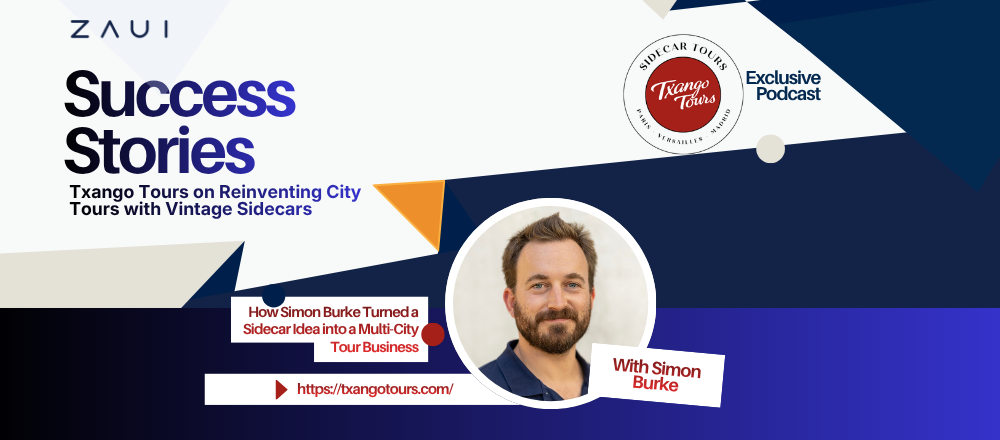


Reinventing City Tours: The Story Behind Txango Tours and the Operations That Power It
From History Teacher to Sidecar Tour Trailblazer
Simon Burke never expected that one day he’d be zipping through Parisian boulevards on a vintage motorcycle sidecar, leading tourists past the Eiffel Tower. A history teacher by training, Simon’s journey took a sharp turn when he discovered his passion for tour guiding. He spent years as a guide and eventually became the European HR Director for a large tour company. Everything changed when the COVID-19 pandemic hit. The tourism industry collapsed, and Simon found himself back home in France’s Basque Country, reflecting on his future. It was there that an old idea resurfaced, one he’d shelved years before when he first saw sidecar tours being offered in Paris. Why not start his own sidecar tour venture? Fueled by a lifelong love of motorcycles and travel, Simon drafted a business plan for what would become Txango Tours ( “Txango” is a Basque word meaning a leisurely excursion). Paris, the City of Lights, would be the proving ground for this unconventional tour experience.
Launching a new tour business in 2021, with global travel only just beginning to rebound, was daunting. Yet Simon embraced the challenge. He knew tourism would bounce back, it was just a matter of time. In July 2021, he left his job and spent the next months laying the groundwork for Txango Tours. He sorted out the legalities (business registration, licenses, insurance) and tapped into his network for essentials like branding and a website. By March 16, 2022 exactly two years after Paris’s first lockdown, Txango Tours welcomed its first guests. It was a modest start (just Simon, one bike, and two passengers at a time), but it felt like the beginning of something big. “My blood was pumping,” Simon recalls of that first tour’s thrill. It was the validation that his leap of faith was worth it.
Carving a Niche in a Competitive City
Paris’s tour market is famously competitive, and sidecar tours were already a known attraction, one established operator had a six-year head start on Simon. Rather than be discouraged, Simon saw this as an opportunity. All he had to do was be better, he thought. That became the guiding strategy: offer a more engaging, higher-quality sidecar tour experience than anyone else.
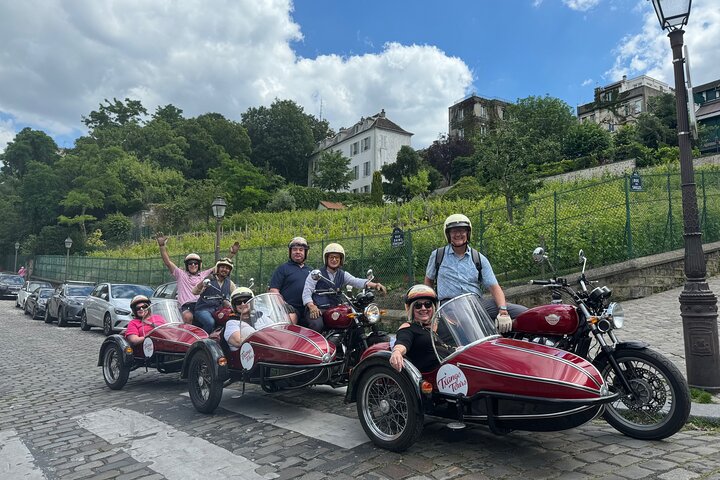
From day one, Txango Tours set itself apart with its personalized, story-rich approach. Many vehicle-based tours simply drive by landmarks with a quick comment (“On your left, the Eiffel Tower…”). Simon’s tours would be different. He leveraged his history background to craft narrative-driven excursions: guides would pull over at key sights, encourage guests to hop out of the sidecar, and dive into immersive storytelling and fun facts. Instead of a drive-by sightseeing checklist, Txango’s guests enjoy intimate conversations about what makes Paris tick, from its iconic monuments to hidden local gems. You can’t get that from a 30-second sound bite on a tour bus. This commitment to deeper engagement turned what could be a gimmicky ride into a truly enriching tour. And customers loved it - “99% love, you have all the thrills of being on a motorcycle without the scary parts,” Simon says of the typical reaction to sidecar tours, noting how even reticent Parisians can’t help but grin and wave at the sight of their vintage rig cruising by.
But delivering these exceptional tours wasn’t going to be a one-man show forever. As a longtime tour guide and HR professional, Simon understood that scaling up meant building a team. For the first season in Paris, he was literally doing it all, he recalls one instance of wedging his phone inside his helmet to take a booking call while driving past Notre Dame! That hustle was unsustainable. Going into 2023, demand was rising (often spilling over from his competitor who was fully booked), and Simon knew it was time to “let go of the handlebars”, both figuratively and literally. He hired and trained a crew of guides and drivers so that he could step back from daily tours and focus on growing the business.
Simon’s hiring philosophy is perhaps Txango’s secret weapon. Having hired hundreds of guides in his past life, he had a clear vision of the personality needed to represent his brand. “If a guide can’t happily tell me about themselves for 30 seconds, how are they going to keep guests engaged for 3 hours?” he quips. Each candidate’s interview was an open-ended chat rather than a stiff Q&A. Simon looked for enthusiasm, curiosity, and that spark that makes someone fun to spend an afternoon with. (He jokingly uses a “two beers and a puppy” test: would you enjoy having a couple beers with this person, and would you trust them to watch your puppy? If yes on both, they’re a keeper.) Skills can be taught, but attitude is innate. With this approach, Simon assembled a team of passionate storyteller-drivers who treat Txango’s tours not just as a job, but as a craft. He invested considerable time in training them on Parisian history, bike safety, customer service, and the art of connecting with guests. Soon, reviews started mentioning these guides by name, praising their knowledge and charisma. Txango Tours was no longer just Simon on a bike; it had grown into a full-fledged brand known for delivering unforgettable city adventures.
Growing Pains and Smart Gains
By the end of 2024, Txango Tours had firmly established itself in Paris. Six guides were leading sidecar trips around the city and into nearby Versailles, earning Txango a reputation as one of the most unique ways to see the sights. Word-of-mouth referrals became a huge driver of business, in fact, by 2025 about 44% of Txango’s direct bookings were coming from past guest referrals and personal recommendations. That kind of organic buzz is gold in the tour industry, and it stems directly from Txango’s commitment to quality and personal touch. As Simon puts it, happy customers tell their friends and they were doing just that.
Still, Simon knew that long-term success would require strategic growth beyond the Paris market. The question was where, when, and how to expand. Scaling a tour operation isn’t about “doing more of the same” indiscriminately, it’s about replicating your success under the right conditions. Simon took a very analytical approach to this question. His initial thought was London, given its tourism volume and proximity to Paris (the Eurostar makes a London-Paris combo trip easy for travelers). He even began the groundwork there. However, he soon encountered regulatory roadblocks: operating sidecar tours in London meant navigating a maze of red tape from Transport for London and other authorities. The costs and complexity of complying with those strict transport regulations were prohibitive for a small outfit like his. Rather than force a square peg into a round hole, Simon pivoted to find a more feasible second city.
All signs pointed to Madrid, Spain. Simon dug into tourism data, from his own booking reports and external market research and noticed that Madrid consistently ranks among Europe’s top destinations for high-spending travelers, right alongside Paris. (For instance, luxury hotel occupancy and investment in Madrid have been surging in recent years as the city vies for more international tourists.) Perhaps more importantly, Madrid had zero existing sidecar tour companies, meaning Txango could be first to market. The city also held personal resonance: Simon speaks Spanish and had spent time in Madrid, and even had a family member there. The decision practically made itself.
In mid-2025, Txango Tours officially launched in Madrid, offering private sidecar rides through the historic plazas and parks of Spain’s capital. Of course, new challenges arose, from shipping bikes over the Pyrenees to dealing with Spanish licensing and insurance but Simon’s team applied the same formula that worked in Paris. They found a local lead guide (a Madrid-based sidecar aficionado named Raphaël), trained up on the routes and stories of Madrid, and hit the ground running. The timing was tricky, their bikes arrived in the peak summer heat of July, when Madrid’s tourism dips (nobody wants to be in a hot sidecar at 38°C!). However, come autumn, bookings picked up as tourists returned. By delivering the same high-caliber experience as Paris, Txango’s Madrid operation earned rave reviews from day one. And Simon achieved a major milestone: Txango Tours was now a multi-city, international tour operator.
Through this expansion, Simon learned that growth is as much about systems as it is about ambition. Running tours in two countries means juggling multiple schedules, teams, and customer bases. It was crucial that his operations could scale without sacrificing the personal touch or going haywire administratively. Thankfully, from the very start, Simon had laid a solid operational foundation, one that would prove instrumental as the business grew.
The Tech Backbone: Forcing Technology to Adapt to the Business
A core part of Txango’s success story lies behind the scenes, in the software and systems that power its bookings and daily operations. Unlike many small tour startups that begin with a mishmash of spreadsheets, emails, and phone calls, Simon chose a more professional path. Drawing on his industry experience, he knew an online reservation system was essential from day one. “You can’t expect to be a professional tour operator without booking software,” he says. For customers, a smooth online booking experience instills confidence; for the operator, it automates the tedious stuff so you can focus on the tour itself.
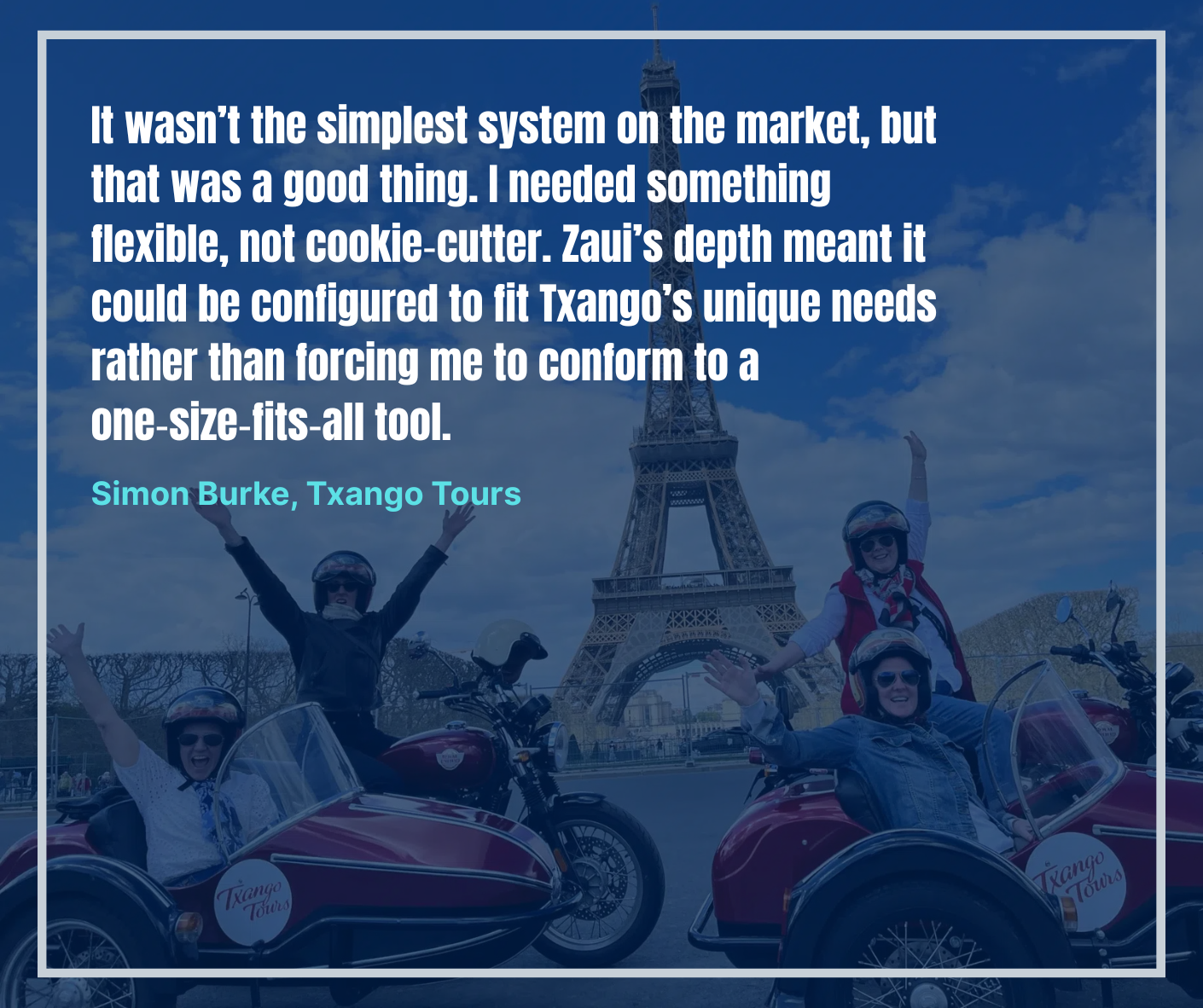
Simon evaluated several platforms, but one had an unfair advantage: Zaui, an all-in-one online booking and business management system for tour operators. He had used Zaui at his previous company and was familiar with its robust capabilities. Zaui is a comprehensive tour booking platform that covers the entire booking journey, from online customer bookings and payments to backend operations like scheduling and resource management. In Simon’s words, it wasn’t the simplest system on the market, but that was a good thing: he needed flexible, not cookie-cutter. Zaui’s depth meant it could be configured to fit Txango’s unique needs rather than forcing him to conform to a one-size-fits-all tool.
Implementing Zaui early gave Txango Tours a backbone for professionalism and scalability. Simon worked with the Zaui team to get the system up and running without hefty upfront costs (a helpful arrangement for a fledgling business). He integrated Zaui’s online booking engine into the Txango website, enabling customers to see live availability and book their sidecar adventure 24/7. This was crucial for a new tour outfit trying to capture international visitors who plan trips outside of European business hours. “Let your customers book 24/7” is a mantra Zaui lives by, travelers from around the world could instantly secure a tour on Simon’s site without playing email tag. The effect was immediate: bookings started flowing in even while Simon slept, and he woke up to new reservations neatly organized in the system.d
Beyond convenience, Zaui gave Txango a treasure trove of data that Simon enthusiastically put to work. The platform’s customizable reporting tools allowed him to slice and dice his booking data for insights on customer origin, booking lead times, and sales trends. “I don’t like making guesswork decisions. I like seeing empirical data,” Simon remarks, and Zaui made that easy. For example, by capturing guests’ phone numbers during checkout, Simon could parse the country and area codes to learn exactly where his customers were coming from. He discovered patterns, e.g. a large share of bookings were from North American cities like Dallas and Toronto which informed his marketing strategy. If a lot of Texans were riding sidecars in Paris, why not invest a bit more in targeted ads or travel agent partnerships in Texas? Furthermore, knowing many clients were families, Simon used school holiday calendars for those locales to time his promotions. When Dallas schools were off for spring break, Txango’s online ads would quietly ramp up in Texas. These data-driven tactics ensured marketing dollars were spent efficiently, right when and where customers were in the trip-planning mindset. It’s a perfect example of making technology adapt to the business: Simon configured Zaui to collect the data he deemed important and built campaigns around the trends it revealed, rather than blindly following generic marketing calendars.
The reporting power also helped Simon keep a pulse on his growth. He closely watches booking pace, essentially the rate of bookings this year versus last year as a key health metric. If pace slows, it’s a red flag to investigate whether something’s off in the market or if a campaign is needed. If it accelerates, it validates expansion plans or hiring more staff. With Zaui, Simon can easily pull year-over-year booking reports and even export data to crunch further. As Zaui highlights, operators can “gain valuable insights into bookings, sales, and customer behavior with Zaui’s customizable reports”, a benefit that Txango leverages fully.
Multi-channel sales is another area where technology enabled Txango’s growth. In the tours industry, reaching customers through multiple avenues (your website, online travel agents, hotel concierges, local travel agencies, etc.) is crucial. Zaui’s platform includes channel management tools to connect with major Online Travel Agencies (OTAs) like Viator and GetYourGuide, as well as features to handle agent bookings and reseller partnerships. Simon did list Txango’s tours on a few OTAs for visibility, but unlike many startups, he did not rely heavily on them (OTAs contributed less than 10% of his Paris revenue). Instead, he focused on direct bookings and strategic B2B partnerships, where he could maintain more control over the guest experience and margins. Zaui proved valuable here too: Simon set up custom commissionable rates in the system for his hotel and destination management company (DMC) partners, making it seamless for them to book Txango tours for their clients. A hotel concierge, for instance, could use Txango’s agent portal or call Simon for a last-minute booking, and Zaui would handle the inventory update and send a confirmation instantly. Simplifying these B2B transactions helped Txango carve out a sweet spot with luxury travel planners who appreciated the quick service. It was a win-win: partners got a reliable, cool offering for upscale clients, and Simon filled more tour slots without expensive advertising, all managed through one central system.
Crucially, Zaui’s flexibility meant Simon didn’t have to bend his operations to fit the software; the software could be tailored to fit his operations. As an example, Txango’s tours have very specific capacities and resource constraints, each sidecar can take two passengers, and each guide can only handle one sidecar at a time, obviously. Simon used Zaui’s resource management features to ensure the booking engine would never overbook beyond the number of sidecars or available guides for a given time slot. If he needed to block off a day because a guide was unavailable or add a special tour schedule, the system was adaptable to those needs. This prevented the nightmare of accepting bookings that he couldn’t fulfill. In short, Zaui became the silent engine humming underneath Txango’s customer-facing glamour, keeping inventory in check, payments processed, schedules synced, and data flowing.
Adapting, Learning, and Looking Ahead
In just a few years, Txango Tours grew from a single-bike passion project into a two-country operation offering some of the most unique city tours in Europe. The journey so far offers a few powerful lessons for tour operators and travel entrepreneurs:
- Find Your Unique Angle and Excel at It: In a crowded market like Paris, Txango succeeded by doing something different, vintage sidecars and executing it better than anyone else. Quality and memorability earn repeat business and referrals, which are marketing gold. As one travel writer noted after touring with Simon, even jaded locals light up when they see a sidecar cruise by. If your tour product turns heads and brings genuine smiles, you’re onto a winner.
- Invest in Your Team and Culture: Simon’s first hire was not a marketing guru or a CFO, but more guides. Empowering others to deliver your vision is key to scaling. He hired for personality and trained for skill, creating a team that is as invested in guest satisfaction as he is. Also, don’t forget to have fun, a team that plays together, stays together. Txango’s crew bonds over beers and karaoke nights, which translates into camaraderie on the job. Happy guides = happy guests.
- Leverage Data for Decision-Making: Flying blind is for fighter pilots, not tour businesses. From choosing Madrid as an expansion city to tweaking advertising spend, Simon let data inform his moves. Tour operators have access to more data than ever; the trick is to actually use it. Know where your customers come from, how far in advance they book, which tours sell best, and so on. These insights helped Txango optimize pricing, timing, and marketing, driving year-over-year growth. A robust booking system like Zaui makes this data accessible so you can act on trends. In Simon’s case, data showed him when to market (around school holidays) and where (cities with lots of past guests), taking the guesswork out of growth strategies.
- Force Your Tech to Adapt to You, Not Vice Versa: Simon refused to let technology dictate the terms of his business. Instead of accepting limitations of a basic booking app, he chose a platform he could mold. He collected the info he deemed important (even something as quirky as phone country codes) and created workflows suited to his tour operations. The result was a tailored system that served his needs, essentially like having a digital staff member. Modern tour tech like Zaui is designed to be flexible; don’t be afraid to configure and customize it. As your business evolves (new tours, new locations, new partners), ensure your tech evolves with it.
- Balance Distribution Channels: Txango’s approach to sales channels was very strategic. Direct online bookings through a branded website were the bread-and-butter (strengthening the brand and avoiding hefty commissions). Yet Simon also nurtured on-the-ground partnerships (hotels, travel agents) that yielded high-value clients. He maintained a presence on OTAs for exposure but didn’t become dependent on them. This balanced distribution, managed centrally via his reservation system, gave Txango both control and reach. For other operators, the takeaway is to diversify your sales streams in a manageable way and use technology (like channel managers, agent portals, promo codes, etc.) to keep it efficient.
As Txango Tours eyes the future, it isn’t resting on its laurels. Simon hints that Italy might be the next destination in his crosshairs, imagine sidecar tours through the streets of Rome or Florence! Wherever Txango goes next, its operational backbone will be ready. In fact, the technology powering the business keeps advancing. Zaui recently introduced “Nera,” an artificial intelligence (AI) assistant built into the platform to help operators forecast demand and optimize their operations. “Nera is Zaui’s AI (Artificial Intelligence) solution to analyze your business data, a smart, friendly assistant making sense of complexity so you can make decisions with confidence,” explains Zaui’s introduction of the tool. In practical terms, this AI will scan through Txango’s historical booking patterns and market data to suggest things like adding extra tour departures when a surge is predicted, or adjusting pricing for peak vs. off-peak times to maximize revenue. For a data-lover like Simon, features like this are incredibly exciting. It’s like having a data analyst on staff, crunching numbers in the background and whispering recommendations. As Txango grows, such smart tools will help ensure the company stays proactive rather than reactive, spotting trends and opportunities ahead of time.
Reflecting on Txango’s story, it’s clear that this “customer success” is a product of both heart and savvy. Simon Burke poured his passion, expertise, and endless energy into creating a one-of-a-kind tour experience. At the same time, he embraced innovation from rethinking how a city tour could be delivered, to harnessing a powerful software platform to run operations with the finesse of a far larger company. In an industry as old as travel, that combination of creativity and smart systems is reinventing what a tour operator can be.
For fellow tour operators and travel professionals reading this, Simon’s journey offers inspiration and a blueprint. Reinventing city tours doesn’t require reinventing the wheel; often, it means refocusing on the core of what makes travel special (unique experiences and human connection) and enabling it with the right tools. Txango Tours shows that even a small startup can make waves in a big destination when fueled by a clear vision and supported by adaptable tech. As the world of tours and activities continues to evolve, those who marry passion with data-driven operations will be the ones leading the pack or in Simon’s case, leading the pack on a gleaming Royal Enfield sidecar, cruising through the city with the wind in their hair and a satisfied customer by their side.
✍️ Pro Tip for Operators: Take a page from Txango Tours, audit your own business for opportunities where technology can save you time, provide insights, or improve the guest experience. It could be implementing an online booking system if you haven’t yet, or diving into your existing booking reports to uncover hidden trends. And never underestimate the power of a personal touch; no amount of tech can replace an unforgettable tour led by a guide who loves what they do. In the end, success comes from delivering value and using all the tools at your disposal to run a smarter operation.
Txango’s story is still being written, but one thing’s for sure: with leaders like Simon and platforms like Zaui working in tandem, the future of city tours is looking very bright indeed.
Related Case Studies

Frequently Asked Questions
No. Zaui’s pricing is fully pay-as-you-go. You aren’t locked into any long-term contract. In fact, leading platforms emphasize this flexibility. Similarly, Zaui lets you start and stop anytime. You can change or cancel your plan freely, so you only pay for what you use.
Absolutely not. Zaui’s pricing is 100% transparent. We disclose all fees up front with no surprise add-ons or “sneak-in” charges. In fact, Zaui’s plans include all core features “without additional fees”. Industry experts note that hidden fees undermine trust so we avoid them entirely. All costs are clearly outlined in our pricing, and there are no extra setup charges or undisclosed surcharges at checkout.
Zaui integrates with major payment gateways (e.g. Stripe) so you only pay standard credit-card processing rates (roughly 1.9%+$0.30/transaction) and we don’t mark them up. Only the published platform commission is added on bookings. You also have full control over who pays the commission, we let you decide whether to absorb booking fees or pass them on to customers. In short, you’ll only pay the transparent booking commission and normal gateway fees, nothing extra.
Your onboarding and support are included in the price. We provide white-glove setup help and ongoing 24/7 support at no additional cost. Our dedicated customer-success team will guide you through every step, ensuring a smooth launch. You won’t pay extra for training or service other than the onboarding fee; it's all built into your plan.
You can schedule a free demo with our team. Our Zaui ninjas will walk you through pe how Zaui can work for your business and highlight opportunities to grow with our advanced features all without any upfront payment. This way, you can feel confident it’s the right fit before making a commitment.
Of course. Zaui’s plans are fully flexible. You can upgrade or downgrade at any time to match your needs, without penalties. You can move to a higher tier or back down easily, and your billing adjusts automatically.
No. Zaui does not charge its commission on offline/manual bookings. “No fees on offline bookings” You only pay the commission when a booking is processed online through our system. Manual reservations (or bookings from partner channels we set up for you) incur no extra platform fee. (30% or less)
All of Zaui’s core features are included in your plan at no extra charge. We believe in value and transparency: Zaui provides over 15 advanced features (Google Things to do, reporting tools, marketing tools, reports, etc.) at no additional cost. Many competitors charge extra or require higher plans for the same features, but with Zaui you get the full suite of tools in one package. Any optional add-ons (if any) will always be clearly listed and optional there are no surprise paid upgrades for standard features.
Each Zaui plan is designed for clarity and fairness, following industry best practices. You can trust that our pricing is transparent and flexible, with the support you need built in.
Extra accounts- unlimited agents, resellers, user
