


Introduction
There is a category error that trips up a lot of operators early in their software search. They go looking for a booking system, find something that takes payments online, and discover six months later that they are still managing guide schedules in a spreadsheet, manually checking whether the kayaks are available before confirming a booking, and fielding calls from customers who did not get their reminders. What those operators needed was not just a booking engine. They needed an activity management system -- software that handles the full operational picture of running experiences, not just the checkout.
The distinction matters because the two categories have different capabilities, and choosing based on the wrong criteria leads to gaps that accumulate over time into real operational problems. This guide explains what activity management software does, how it differs from a booking engine, which features actually matter for experience operators, how major platforms handle the activity management use case, and how Zaui approaches the combination of tours, activities, and transportation in a single system.
What Is Activity Management Software?
Activity management software is a platform that handles both the customer-facing booking process and the internal operations of running experiences: scheduling, resource assignment, capacity tracking, staff communication, OTA channel distribution, and reporting. The activity label is broader than it might sound. In this context, an activity is any bookable experience with a fixed schedule, defined capacity, and resource requirements -- a kayaking tour, a cooking class, a wine tasting, a whale watching trip, a scenic helicopter flight, a guided hike, a zip-line session, or a historical walking tour.
What separates activity management software from a generic booking tool is the operational layer. A booking tool takes a customer's payment and records a reservation. An activity management system does that plus assigns specific resources to that booking, tracks the availability of those resources across all bookings, prevents the same resource from being assigned to two different activities simultaneously, adjusts capacity dynamically when resources are unavailable, and provides staff with the information they need for each scheduled session.
The Difference Between a Booking Engine and an Activity Management System
A booking engine is the customer-facing component that converts a website visitor into a paying customer. It shows available dates and times, collects payment, sends a confirmation, and records the reservation. An activity management system includes a booking engine but extends well beyond it. The additional capabilities are primarily operational: resource management knowing that you have 12 kayaks, that 4 are being serviced this week, and that 8 are already assigned to the 9 AM tour; staff scheduling knowing which guides are certified for which activities and which days they are available; session management with its own record showing who is booked, who has checked in, and what equipment has been assigned; manifests and run sheets for your operations team; and OTA channel integration that pushes your availability to external channels and pulls incoming bookings back into your central inventory.
Core Capabilities for Activity Operators
Real-Time Availability Across All Channels
Every time a booking arrives -- through your website, through Viator, through GetYourGuide, through a hotel concierge using a booking desk tool, or through a walk-in phone call -- your available capacity needs to update immediately across every other channel. This is the minimum viable requirement for any activity management system. Without it, you oversell, you disappoint customers, and your reviews suffer.
Resource Scheduling and Conflict Prevention
Define your resources -- guides, vehicles, equipment, venues, courseware -- and assign them to each activity session. The system prevents any resource from being double-booked. When a guide calls in sick or a piece of equipment goes out of service, the system should make it straightforward to reassign resources and, if necessary, notify affected customers automatically.
Capacity Management by Session
Activity capacity is multidimensional. You might have 20 seats on a sunset cruise, but 4 are reserved for a travel agent's clients, 2 are blocked for staff, and 6 have already been booked through Viator. Your system needs to track all of these simultaneously and show customers the accurate remaining availability.
Staff Communication and Daily Manifests
Your guides need to know who is coming, what they booked, any special requirements noted at booking, and what time they are expected at each pickup point. Activity management software should generate these manifests automatically and make them accessible to your staff -- whether through a dashboard, a printed sheet, or a mobile app.
Automated Customer Communication
At minimum: instant booking confirmation with all relevant details, pre-activity reminder one to two days before with what to wear and where to meet, same-day reminder with start time, and post-activity follow-up with a review request. The content of these messages matters as much as the timing. Generic confirmations that omit critical details generate support calls that your team has to handle manually.
OTA Channel Management
An activity management system with built-in channel management handles OTA inventory automatically. When a Viator customer books the last 3 spots on your 10 AM session, those spots disappear from your website booking widget and from every other connected channel simultaneously.
Reporting and Business Intelligence
Which activities generate the most revenue? Which sessions consistently undersell? What is your average booking window? Good activity management software surfaces this information in dashboards your team can check without building custom reports.
Resource Scheduling in Depth
Resource scheduling is the capability that separates activity management systems from simpler booking tools. Suppose you operate adventure tours with 3 certified guides, 8 kayaks, 1 shuttle van, and 1 zip-line course. Your 9 AM Saturday schedule includes a kayak tour (8 participants, requires 8 kayaks and 1 guide), a zip-line tour (6 participants, requires the course and 1 guide), and a hiking tour (10 participants, requires the van and 1 guide). All three run simultaneously. If a fourth tour group tries to book a 9 AM kayak tour, the system should recognize that all kayaks and all available guides are already committed and show zero availability. If one guide cancels Saturday morning, the system should immediately surface the conflict so your operations team can resolve it before it affects customers.
Google Things to Do Integration
Google Things to Do allows your activities to appear directly in Google Search and Google Maps results with a Book Now button. For activity operators, this is a meaningful source of direct bookings at zero OTA commission. The integration requires that your booking system connects to Google's API and keeps your availability and pricing current in real time. Several activity management platforms support this integration, including Zaui. The setup requires meeting Google's product quality requirements and completing a technical onboarding process. Once live, the integration runs automatically.
How Zaui Handles Activities and Tours Together
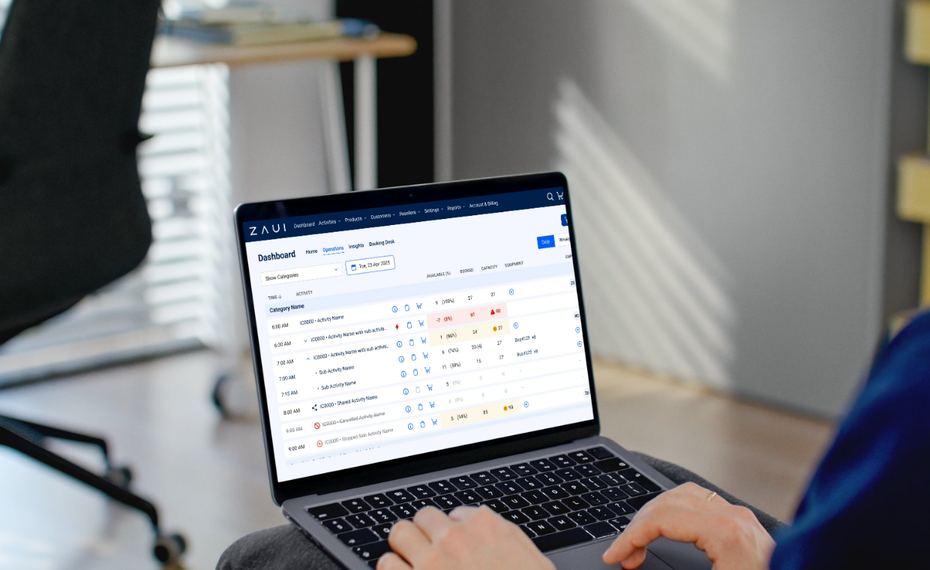
Zaui is designed to handle tours, activities, and transportation in a single platform -- the core inventory model does not distinguish between a 4-hour kayak tour, a daily helicopter experience, and a scheduled shuttle route. All of them share the same resource management, channel distribution, and reporting infrastructure. This matters for activity operators who also run transport and for transportation operators who have added experiential products. Specific capabilities relevant to activity operators in Zaui include session-level resource assignment for guides, equipment, and venues; Booking Desk for in-person and phone bookings by front-desk staff; OTA channel distribution to Viator, GetYourGuide, and other partners; dynamic pricing tools; NERA AI operations alerts for flagging issues proactively; Google Things to Do integration; and a free plan for operators who are getting started.
Platform Comparison: Activity Management Capabilities
Zaui: Handles tours, activities, and transportation in one system. Strong resource scheduling, OTA distribution, and Google Things to Do support. NERA AI proactive operations alerting. Free plan available. Best for operators with a mixed product set including transport, or who need robust multi-day and session management.
FareHarbor: Widely used for activity and day-tour operators. Strong OTA network and a polished booking widget. Commission-based pricing model. Resource management is available but less structured than platforms built for complex scheduling. Best for activity operators who prioritize ease of setup and OTA reach.
Rezdy: Built for activity-first operators with a strong OTA distribution network. Clean interface for standard day-activity booking. Scheduling tools are functional but less deep for complex resource management. Best for operators whose primary need is broad OTA connectivity.
Checkfront: Handles a mix of activities, tours, and rentals. Subscription-based pricing. Resource management features are available. OTA connectivity is more limited. Best for operators running varied experience types who want predictable monthly costs.
Key Takeaways
Activity management software is not just a booking engine. The resource scheduling, staff coordination, channel distribution, and operations visibility it provides are what allow operators to run multiple simultaneous activities reliably without constant manual intervention. The right platform depends on your product mix, the complexity of your resource constraints, and how you sell. Before selecting any platform, walk your most complex operational day through a demo: multiple simultaneous activities, a guide unavailability scenario, and a channel booking that comes in while you are at capacity.
FAQ
What is activity management software? Activity management software is a platform that handles both the customer booking process and the internal operations of running experiences -- scheduling, resource assignment, capacity tracking, staff communication, OTA channel distribution, and reporting. It goes beyond a basic booking engine by managing the operational layer that keeps activities running without manual intervention.
What is the difference between an activity management system and a booking engine? A booking engine is the customer-facing checkout component: it shows availability, takes payment, and sends a confirmation. An activity management system includes a booking engine but also manages resources, prevents double-booking, generates staff manifests, syncs inventory across OTA channels, and provides operational alerts and reporting.
What is the best activity management system for tour operators? It depends on your product mix and operational complexity. Zaui is a strong choice for operators who run a combination of tours, activities, and transportation. FareHarbor and Rezdy are widely used for activity-first operators. The right system depends on your resource constraints, OTA channels, and whether you need multi-day or transport capabilities.
How does activity management software handle resource scheduling? You define your resources -- guides, equipment, vehicles, venues -- and the system assigns them to specific activity sessions. When a resource is committed to one session, the system prevents it from being assigned to any overlapping booking. If a resource becomes unavailable, the system surfaces the conflict so your team can resolve it before it affects customers.
Which activity management systems integrate with Google Things to Do? Zaui supports Google Things to Do integration, allowing your activities to appear in Google Search and Maps with a Book Now button. Several other platforms also support this integration. The setup requires meeting Google's product quality requirements and completing a technical onboarding process.
Can Zaui manage both tours and activity-based experiences? Yes. Zaui handles tours, activities, and transportation in a single platform. The inventory model treats all bookable products -- a kayak tour, a guided hike, a scenic helicopter flight, a shuttle route -- with the same resource management, channel distribution, and reporting infrastructure.
How does activity management software handle OTA channel distribution? A channel manager in the software pushes your availability and pricing to connected OTAs in real time. When a booking comes in from any channel, the system automatically reduces available inventory everywhere else. This prevents overselling and eliminates the need to manually update availability on each channel after every booking.
What is a daily manifest in activity management software? A daily manifest is a report generated for each scheduled activity session, showing all booked participants, their booking notes, contact information, and any relevant operational details like pickup logistics. Activity management software generates these automatically so your guides and operations team have what they need for each session without manual preparation.
Does activity management software support dynamic pricing? Some platforms do. Zaui includes dynamic pricing tools that let you adjust activity prices automatically based on demand, capacity, and time until departure. This allows you to capture higher revenue from popular sessions and fill underbooked sessions with lower pricing.
How long does it take to set up activity management software? A single-activity operation can typically be live within a few days. A multi-product operation with shared resources, OTA channel connections, and custom pricing rules takes longer -- typically several weeks of configuration and testing. Platforms with hands-on onboarding support shorten this timeline considerably.
Related Posts

Frequently Asked Questions
No. Zaui’s pricing is fully pay-as-you-go. You aren’t locked into any long-term contract. In fact, leading platforms emphasize this flexibility. Similarly, Zaui lets you start and stop anytime. You can change or cancel your plan freely, so you only pay for what you use.
Absolutely not. Zaui’s pricing is 100% transparent. We disclose all fees up front with no surprise add-ons or “sneak-in” charges. In fact, Zaui’s plans include all core features “without additional fees”. Industry experts note that hidden fees undermine trust so we avoid them entirely. All costs are clearly outlined in our pricing, and there are no extra setup charges or undisclosed surcharges at checkout.
Zaui integrates with major payment gateways (e.g. Stripe) so you only pay standard credit-card processing rates (roughly 1.9%+$0.30/transaction) and we don’t mark them up. Only the published platform commission is added on bookings. You also have full control over who pays the commission, we let you decide whether to absorb booking fees or pass them on to customers. In short, you’ll only pay the transparent booking commission and normal gateway fees, nothing extra.
Your onboarding and support are included in the price. We provide white-glove setup help and ongoing 24/7 support at no additional cost. Our dedicated customer-success team will guide you through every step, ensuring a smooth launch. You won’t pay extra for training or service other than the onboarding fee; it's all built into your plan.
You can schedule a free demo with our team. Our Zaui ninjas will walk you through pe how Zaui can work for your business and highlight opportunities to grow with our advanced features all without any upfront payment. This way, you can feel confident it’s the right fit before making a commitment.
Of course. Zaui’s plans are fully flexible. You can upgrade or downgrade at any time to match your needs, without penalties. You can move to a higher tier or back down easily, and your billing adjusts automatically.
No. Zaui does not charge its commission on offline/manual bookings. “No fees on offline bookings” You only pay the commission when a booking is processed online through our system. Manual reservations (or bookings from partner channels we set up for you) incur no extra platform fee. (30% or less)
All of Zaui’s core features are included in your plan at no extra charge. We believe in value and transparency: Zaui provides over 15 advanced features (Google Things to do, reporting tools, marketing tools, reports, etc.) at no additional cost. Many competitors charge extra or require higher plans for the same features, but with Zaui you get the full suite of tools in one package. Any optional add-ons (if any) will always be clearly listed and optional there are no surprise paid upgrades for standard features.
Each Zaui plan is designed for clarity and fairness, following industry best practices. You can trust that our pricing is transparent and flexible, with the support you need built in.
Extra accounts- unlimited agents, resellers, user
